
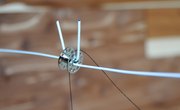
A rope lifting or pulling a load undergoes tension, a force determined by the mass of the load and other factors. You calculate it by determining the force of gravity from the load, plus the effect of any accelerations and other forces acting on the rope. Although gravity always acts in the “down” direction, other forces may not; depending on the direction, you either add them to or subtract them from gravity to arrive at the total tension on the rope. Physicists use a metric unit called the newton to measure force; the tension on a rope suspending a 100-gram weight is roughly 1 newton.
A newton is defined as the force needed to accelerate a 1-kilogram mass by 1 meter per second where no friction is present.
With different circumstances, the force calculation can become complicated. For example, you can bolt the ends of a rope to two opposite walls, making the rope horizontal. If a tightrope walker steps out on the rope, the tension depends on her mass and the force due to gravity, but the angle the rope forms with respect to the wall also affects the tension.
Multiply the weight’s mass in kilograms by 9.8, the acceleration in meters per second squared due to gravity. The result is a downward force in newtons, which accounts for most of the tension on the rope. For example, if you use a rope to suspend a piano that weighs 200 kg, multiply 200 kg by 9.8, giving 18,600 newtons, the tension on the rope.
Subtract the force of the remaining weight on the ground if you’re lifting the object with the rope but it has not yet risen from the ground; the rope is not under the full tension needed to lift the object. For example, you pull hard on a rope to lift a 200-kg piano, but it hasn’t moved. If the piano still exerts a force of 500 newtons on the ground, subtract it from the full force, 18,600 newtons. The tension on the rope becomes 18,600 - 500 = 18,100 newtons.
Multiply the upward acceleration of the weight by its mass and add it to the tension due to gravity. For example, you use an electric winch to lift a 200-kg piano to the fifth floor of a building; the piano accelerates upward at a rate of 1 meter per second squared. One meter per second squared times 200 kg is 200 newtons. If the piano were hanging but not moving, the tension would be simply the force from gravity, 18,600 newtons. If the piano accelerates up, the piano’s mass resists being moved, creating a downward force similar to gravity. Add 200 newtons to the original 18,600 to get 18,800 newtons, which is the total tension.
Tips
References
Tips
- A newton is defined as the force needed to accelerate a 1-kilogram mass by 1 meter per second where no friction is present.
- With different circumstances, the force calculation can become complicated. For example, you can bolt the ends of a rope to two opposite walls, making the rope horizontal. If a tightrope walker steps out on the rope, the tension depends on her mass and the force due to gravity, but the angle the rope forms with respect to the wall also affects the tension.
About the Author
Chicago native John Papiewski has a physics degree and has been writing since 1991. He has contributed to "Foresight Update," a nanotechnology newsletter from the Foresight Institute. He also contributed to the book, "Nanotechnology: Molecular Speculations on Global Abundance." Please, no workplace calls/emails!