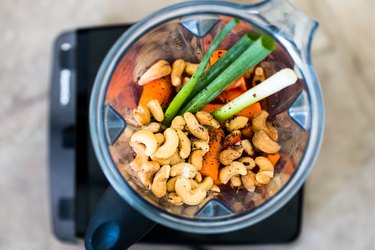
Using a food processor can completely transform the way you approach your meal prep. This kitchen appliance saves time and chops, slices and blends food with consistency, and even prevents the shoulder, neck and back strain that can occur from chopping food the old fashioned way.
Your food processor will become your secret ingredient in no time, but there's a mild learning curve. Don't feel intimidated by all the accessories that come with your food processor. Once you learn how to attach and remove them, it's easy to decide which one to reach for based on the recipe.
Video of the Day
Video of the Day
Using Food Processor S Blade
Your food processor's S blade has two curved blades that sit low inside the work bowl. Depending on which setting you use on the food processor, the S blade can act like a blender by creating purees or it can roughly dice different types of foods. Lock the S blade stem in place within the work bowl, add the food and attach the flat cover. Then, you'll press either "On" for continuous blade action or "Pulse" for a brief chopping action.
It's also important not to overload the work bowl with too much food, since it needs to have room to move around. Prep the food by chopping it into chunks to ensure the blades can reach it. For example, rather than placing an entire onion in your food processor, use a knife and cutting board to chop it into about 8 pieces first. Then, you can further dice it in the food processor by pressing "Pulse" repeatedly until the desired size or texture is achieved.
Any ingredients that need to be pureed can be added to a food processor equipped with an S blade. According to Pinch of Yum, simple food processor recipes to start with include hummus, pesto, salad dressing or curry paste. Using a food processor to speed up your prep time is also possible when you use the pulse feature to crush nuts, dice vegetables or grind meat.
Using Shredding and Slicing Discs
If your food processor comes with shredding and slicing discs, these special blades can help you prep vegetables in no time. Some of the slicing discs are adjustable so that you can make thinner or thicker cuts, whereas other models include several different slicing discs for you to choose from. As Pamela Salzman explains, attaching the discs is a little bit different from brand to brand and model to model, so it's best to consult your owner's manual if possible.
First, however, you'll need to remove the S blade from the work bowl. Then attach the stem adapter to the disc you want to use. Next, secure the stem inside the work bowl by twisting it in or pressing down firmly. Attach the cover that features a "feed tube."
Do a little bit of initial prep work on the food by cutting it to fit inside the feed tube if necessary. Place the food you want to shred or slice in the feed tube and press the "On" button. Use the included food pusher to apply firm, steady pressure on the food to send it through the slicer or shredder. Within seconds, you'll have sliced or shredded food ready to go in a salad, stir fry another dish.