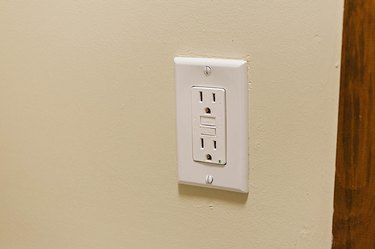
The National Electric Code requires that all receptacles installed in all 15- and 20-amp, 120-volt circuits be grounded. If your house wiring predates the adoption of this requirement, you don't have to replace your ungrounded receptacles with grounded ones. That doesn't have to mean living without grounding protection in your bedroom or kitchen outlet, however. Replacing an ungrounded outlet with a ground fault current interrupting (GFCI) receptacle protects you from shocks, but it won't protect your electronic equipment from power surges.
What Is a Ground Wire and Why Is It Important?
A ground wire is an extra wire that goes down into the ground to prevent shocks and current issues in your electrical items. Until the mid-20th century, residential circuits were ungrounded, which means they had only two wires. Loose connections, worn insulation, and broken internal parts made it easy to get shocks. Whenever you touched a device where a residual current was present, it would travel through your body to the ground. Not only that, but residual current caused metal parts to overheat, making fires more frequent.
To counter this, the NEC began requiring all electrical panels to include a ground bus connected physically to earth through a ground rod. Today, all circuits controlled by the panel must connect to the ground bus through a third conducting wire, and all devices on the circuit must have terminals for this ground wire.
Video of the Day
Do's and Don'ts of Upgrading the Grounding
Because the NEC regulations applied only to new construction, homeowners with existing two-conductor wiring weren't required to make changes. If you live in an older home, and your outlets have no ground wire, your panel may not be grounded. In that case, the best course of action — although an expensive one — is to upgrade your panel. You probably don't want to go to that expense just to ground a single outlet, though, as you have a workable option.
Video of the Day
When upgrading the grounding in your home:
- Don't replace a two-prong outlet with a three-prong outlet. Simply installing an outlet with a third slot that allows you to plug in your three-pin coffeemaker is illegal and dangerous. It doesn't provide grounding. Although you know it isn't grounded, someone else might not and could be injured as a result.
- Don't ground to the electrical box. Connecting the ground wire to a metal electrical box will energize the box in the event of a short circuit. The box could overheat and start a fire, or someone could get a shock from touching it.
- Don't rely on metal sheathing or an exposed ground wire. If your electrical cables have metal sheathing that runs all the way to the panel, the sheathing can serve as a ground path. Alternatively, you might consider connecting the ground terminal to a water pipe by means of an exposed ground wire. Two problems make the safety of these approaches questionable. The connection is often unreliable. The sheathing or wire gets energized in the event of a short circuit, potentially overheating and causing a fire or giving someone a shock.
- When in doubt, don't hesitate to hire a licensed electrician. In fact, unless you're experienced in electrical repairs, that's the first thing you should do,
How to Install a GFCI Outlet
A GFCI outlet monitors the relationship between the current coming into it and the current leaving, and a breaker trips whenever the difference exceeds a preset limit. This provides the same shock and fire prevention that a ground wire provides. It doesn't protect your electronic equipment from a power surge, though, because surge protectors work by shunting excess current through the ground wire to earth.
When replacing your two-prong outlet with a GFCI, an electrician starts by turning off the breaker controlling the outlet circuit and unscrewing the outlet from the electrical box. The rest of the procedure is as follows:
- Disconnect the hot wire, which is black, from the existing outlet and connect it to the brass LINE terminal on the GFCI. It must be connected to this terminal, not to the LOAD terminal or the GFCI won't offer any protection.
- Disconnect the neutral wire, which is white, and connect it to the chrome LINE terminal.
- Leave the ground terminal disconnected.
- Replace the outlet and put a label on it that reads "No Equipment Ground." This label is usually supplied with the outlet, and it warns people against relying on the outlet for surge protection.
You can wire a three-prong outlet to the GFCI by connecting it to the LOAD terminals. That outlet will get ground fault protection from the GFCI. It must also have a label that says "No Equipment Ground."