
How to Learn Math With an Abacus

How to Learn Math With an Abacus thumbnail
Abacus

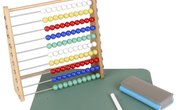
The abacus is one of the earliest recorded tools used in math. The traditional Chinese abacus consists of a frame divided into upper and bottom parts with 13 columns of beads. The upper portion consists of one or two beads and the bottom consists of five beads. The abacus can be used for addition, subtraction, multiplication, and division. This article introduces the use of the abacus in addition and subtraction equations.

Things You'll Need

  • Abacus
Show More

Instructions

    • 1

      Get yourself an abacus. Once you have the apparatus, familiarize yourself with the structure. The beads on the top are worth five times the value as the beads on the bottom. The beads on the bottom are assigned values arbitrarily. In the right most column, beads may be assigned a value of one (units), and beads in the column just to the left may be assigned a value of 10 (tens) and so on.

    • 2

      Tilt the abacus towards you, so all the beads fall to the bottom. Place the abacus on a flat surface with the section that has five beads in each column on the bottom.

    • 3

      Input your first number. Break the number into single digits. If your number is 36, break the beads into 3 tens plus 6 units. From the tens column, move the number of beads equal to the tens digit. In the example of 36, move 3 beads up. From the units column, move the number of beads equal to the units digit. There are only 5 beads on the bottom. In the example of 36, move one bead up from the top (bead is equal to 5) and one bead up from the bottom.

    • 4

      Input your second number. If you are adding, divide the number into digits as explained in Step 3, and move up the beads in addition to those that have been moved up. If you are subtracting, divide the number into digits as explained in step 3, but instead of moving the beads up, bring the beads down from the ones already moved up.

    • 5

      Count the total number of beads in each column. This is the value of each digit. If the value exceeds nine, subtract 10 from the value and add 1 to the digit at the next larger place value. If you have 3 in the hundreds digit, 15 in the tens digit and 2 in the units digit, subtract 10 from the tens digit, and add 1 to the 3 in the hundreds digit. Your total will be 451.

Tips & Warnings

  • If you are dealing with large numbers where the units column is insignificant, you can assign your right-most column a value higher than a unit (ie: 10, 100)

Related Searches:

References

Resources

  • Photo Credit Ansik (flickr.com) under Creative Commons 2.0 Attribution License.

Comments

  • bchicobraun Sep 09, 2009
    Love this article!!!! More people should learn how to use one ;-0)
  • ncworkshop Aug 05, 2009
    I was just about to write an article on using the abacus, then saw yours. Yours is good. I will search for a new topic. The abacus is so fun to use.

You May Also Like

  • How to Learn Physics at Home

    If you've always wondered why gravity exists or are fascinated by the discoveries of Einstein, but don't have the time and money...

  • How to Use an Abacus Step-by-Step

    Have you ever seen a video or a picture of ancient people using an abacus to count? They slide wooden beads around...

  • How to Use Abacus

    Abacus is an ancient Chinese tool used for mathematical operations. You can use an abacus to add, subtract, multiply or even divide....

  • How to Use an Abacus to Help Teach Children Math

    Learning math with an abacus will prepare young children for writing numbers later in their education. An abacus allows children to conceptualize...

  • Abacus Basics

    Abacus Basics.The abacus is an ancient tool that was used to perform basic mathematic equations. It is still used today in some...

  • How to Use a Chinese Abacus

    While the first documentation of a Chinese Abacus has been dated around the 14th century, some form of the abacus or counting...

  • How to Teach Mathematics Using an Abacus

    Before computers and calculators, the abacus taught children about numbers. From ancient times, teachers have been teaching mathematics using an abacus. The...

  • Chinese Invention of the Abacus

    The abacus was invented by the Chinese in approximately 3000 BC, and was designed to aid in simple mathematical calculations. The design...

  • Math Learning Disability Strategies

    Students can use an abacus for help with computation. Rechenrahmen image by Yvonne Bogdanski from Fotolia.com

  • How to Make an Abacus

    An abacus is like a calculator except you use beads, not a number pad, to do your arithmetic. It has been used...

  • How to Use a Chinese Abacus to Multiply & Divide

    The Chinese abacus, or "Suan Pan," is an calculation device that has been used for over 800 years. The abacus itself is...

  • Math Learning Center Ideas for Fifth Grade

    A learning center math curriculum should be taught using grade-appropriate lessons, and include interactive activities, learning games, printable worksheets, hands-on ...

  • How to Use a Chinese Abacus Online

    The Chinese abacus is an instrument used for calculating numbers. Evidence of the use an instrument used for calculations has been seen...

  • Math Strategies for Kids With Learning Disabilities

    Children with learning disabilities may have trouble in math for different reasons. They may struggle with the language, organization, computation or visual...

  • How to Use an Abacus With Nine Beads

    A nine-bead abacus is a simplified version of a calculation instrument used in China, Japan, Russia and other countries for centuries. Working...

  • How to Use a Child's Abacus

    An abacus is an age-old device used in mathematical calculations. Historians believe the abacus dates back to ancient Mesopotamia, and was used...

  • How to Count Beads

    Before the inception of numbers, humans used stones to calculate sums. The abacus is just one tool used by ancient people to...

Related Ads

Featured