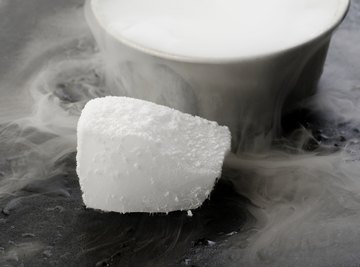

Whether you use it in elaborate culinary creations, to introduce magic tricks or for more scientific pursuits, dry ice can be a lot of fun. You can even craft your own mystical crystal ball and take your party centerpiece to the next level. You can make liquid CO2 at home with a few simple steps, but you'll need to make sure you follow some very important guidelines to stay safe and prevent injury.
What Is Liquid CO2?
Carbon dioxide, or CO2, behaves in very unusual ways and allows you to see the three states of matter in one material. It freezes directly from a gas into a solid, called dry ice, at normal atmospheric pressures, bypassing the liquid phase entirely. This transformation happens at temperatures below -109.3 degrees Fahrenheit at a pressure of 1 atmosphere.
If you increase the pressure to 5.1 atmospheres, which is about 75 pounds per square inch, and maintain the temperature below minus 69 degrees Fahrenheit something very interesting happens. Known as the triple point, these conditions allow CO2 to coexist in the solid, liquid and gaseous states. You can do this yourself at home, but you'll need to watch closely as the gas will only take on a liquid form for a few seconds.
To maintain liquid CO2 on an industrial basis, manufacturers must use sophisticated equipment to create and store the liquid.
How to Make Liquid CO2
First, you'll need to purchase dry ice, available from hardware and grocery stores. Bring a cooler of ice with you to keep it cold on the journey back home.
Using a hammer chip the dry ice into smaller chunks resembling crushed ice.
Cut off the narrow portion of the tip end of a plastic pipette with scissors so that there is a large opening, and collect some of the dry ice in the bulb end.
Crimp and close the pipette's open end using needle-nose pliers.
Holding the sealed pipette with the pliers, submerge it in a clear container of warm tap water.
The plastic bulb will expand as the frozen CO2 thaws. As the pressure builds to above 5.1 atmospheres in the pipette, liquid CO2 will appear in the bulb. After a few seconds, the bulb will burst, and some of the CO2 will revert back to a solid. The rest will become a gas that will form bubbles in the water.
Safety First
If dry ice comes into direct contact with your skin it can cause frostbite or burning, follow these steps to stay safe.
It's really important to protect yourself and store dry ice properly as The University of Vermont advises that if stored in a way where the CO2 cannot escape there is a danger of explosion.
Keep your hands protected from burns by wearing thick heavy-duty gloves.
Protect your eyes by keeping safety goggles on when dealing with liquid CO2 and dry ice.
References
Tips
- Wear insulated gloves to protect against frostbite and burn when handling dry ice. Be careful not to inhale carbon dioxide fumes directly.
Warnings
- Don't store a dry ice pack in your freezer, because its low temperature will cause the freezer's thermostat to turn off. However, if your freezer suddenly breaks, a pack of dry ice will keep things cold for a few hours.
About the Author
Fiona Tapp is a freelance writer and educator. Her work has been featured on The Washington Post, HuffPost, The Toronto Star, The Nest, Brit+Co, and others. She writes about a variety of topics including Homes, Parenting, Education, and Travel. Fiona is a former teacher and masters degree holder.
Photo Credits
chorboon_photo/iStock/Getty Images