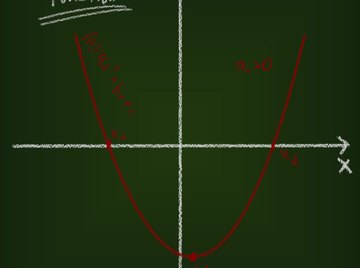

A quadratic equation is an expression that has an x^2 term. Quadratic equations are most commonly expressed as ax^2+bx+c, where a, b and c are coefficients. Coefficients are numerical values. For example, in the expression 2x^2+3x-5, 2 is the coefficient of the x^2 term. Once you have identified the coefficients, you can use a formula to find the x-coordinate and the y-coordinate for the minimum or maximum value of the quadratic equation.
If there is not a number before a variable, the coefficient is 1. For example, if your expression is x^2+5x+1, the x^2 coefficient is 1.
Determine whether the function will have a minimum or a maximum depending on the coefficient of the x^2 term. If the x^2 coefficient is positive, the function has a minimum. If it is negative, the function has a maximum. For example, if you have the function 2x^2+3x-5, the function has a minimum because the x^2 coefficient, 2, is positive.
Divide the coefficient of the x term by twice the coefficient of the x^2 term. In 2x^2+3x-5, you would divide 3, the x coefficient, by 4, twice the x^2 coefficient, to get 0.75.
Multiply the Step 2 result by -1 to find the x-coordinate of the minimum or maximum. In 2x^2+3x-5, you would multiply 0.75 by -1 to get -0.75 as the x-coordinate.
Plug in the x-coordinate into the expression to find the y-coordinate of the minimum or maximum. You would plug -0.75 into 2x^2+3x-5 to get 2_(-0.75)^2+3_-0.75-5, which simplifies to -6.125. This means the minimum of this equation would be x=-0.75 and y=-6.125.
Tips
References
Tips
- If there is not a number before a variable, the coefficient is 1. For example, if your expression is x^2+5x+1, the x^2 coefficient is 1.
About the Author
Mark Kennan is a writer based in the Kansas City area, specializing in personal finance and business topics. He has been writing since 2009 and has been published by "Quicken," "TurboTax," and "The Motley Fool."
Photo Credits
MattZ90/iStock/Getty Images