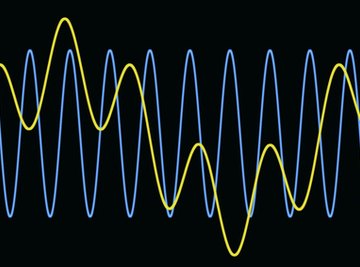

As a unit of wave frequency, a hertz is equal to one cycle per second. The hertz is used widely in the study of electromagnetic waves, and by extension the study of matter itself, because everything in the universe consists of vibrating atoms. It's also common in electric technology, because electricity is generated by rotating turbines that create current that alternates with a fixed frequency.
If you know the frequency (f) and wavelength (λ) of a waveform, you can multiply these together to obtain the velocity of the wave:
Consequently, you can derive the frequency if you know the velocity and wavelength:
To get frequency in hertz, the velocity must be in "units of length" per second, and the wavelength must be measured in the same "units of length." For example, if velocity is measured in m/s, the wavelength must be measured in meters.
Where Does the Word "Hertz" Come From?
Heinrich Hertz (1857–1894) was one of the most important scientists of the nineteenth century. The famously self-effacing physicist was responsible for, among other things, the discovery of the photoelectric effect, which helped form the foundation for modern quantum theory. Hertz also discovered radio waves, which have numerous modern applications in wireless technology, astrophysics and elsewhere. To honor Hertz, a consortium of scientists gathered in 1930 and named the unit of frequency after him.
Use a Hertz Conversion Table to Convert Angular Velocity
One application for hertz units is when considering the rotation of a body around a central pole. In this context, when angular velocity is measured in radians per second, it can be converted directly to hertz by multiplying by a factor of 2π, which is the number of radians in a circle.
In other words, since there are 2π radians in a circle, one radian per second is equal to 1/2π Hz = 0.1592 Hz. Conversely, 1 complete cycle being equal to 2π radians, it follows that 1 hertz = 2π radians per second = 6.283 rad/s.
If you don't want to manually convert between radians per second (or degrees per second) and hertz, you can always consult a hertz conversion table online. They also help you convert from frequency in microseconds to hertz or frequency in any other unit to hertz.
Calculating Hertz from Wavelength and Wave Velocity
Suppose you measure the distance between a pair of ocean waves to be 25 feet. You time how long it takes for the wave to pass a pair of reference points and calculate that it's moving about 15 miles per hour. Can you calculate the wave frequency in hertz? The answer is yes, but first you have to convert all the time intervals to seconds and express all distances in the same units. In this case, the easiest way to do this is to convert wave speed to feet/second:
The frequency in hertz is then:
This is essentially the same procedure scientists use when calculating the frequencies of electromagnetic waves and electrical impulses. When dealing with electromagnetic or electrical phenomena, the wavelengths are much shorter and the velocities much greater, so the frequencies are correspondingly higher. To make calculations easier, scientists assign the prefixes commonly used in the SI measurement system:
- 1 nanohertz = 10-9 Hz
- 1 microhertz = 10-6 Hz
- 1 millihertz = 10-3 Hz
- 1 kilohertz = 103 Hz
- 1 megahertz = 106 Hz
- 1 gigahertz = 109 Hz
- 1 terahertz = 1012 Hz.
References
Resources
About the Author
Chris Deziel holds a Bachelor's degree in physics and a Master's degree in Humanities, He has taught science, math and English at the university level, both in his native Canada and in Japan. He began writing online in 2010, offering information in scientific, cultural and practical topics. His writing covers science, math and home improvement and design, as well as religion and the oriental healing arts.
Photo Credits
harmonic waves diagram, background image by JoLin from Fotolia.com