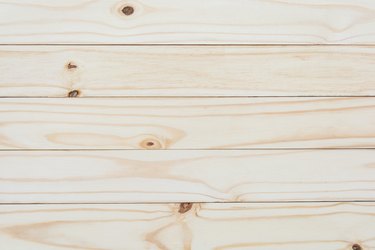
After the rubber tree (Hevea brasiliensis) has yielded its sap to latex harvesters for 30-plus years and has become depleted, it performs one last service and yields its wood to the lumber industry. Because it's a large tree that can grow to 100 feet with a 3-foot diameter, there's a lot of it, and it's known in the industry as rubberwood, parawood, or Malaysian oak.
Rubberwood is commonly fashioned into furniture by workers in the places where the trees grow in plantations (mostly Brazil and Southeast Asia), and a very limited amount is available as raw lumber. Whether you're making new furniture from rubberwood or refinishing existing furniture, you'll probably want to stain it because its natural coloration and grain pattern are somewhat uninteresting. Rubberwood accepts stain well, but you may want to first use a conditioner to avoid blotchiness.
Video of the Day
Video of the Day
Characteristics of Rubberwood
Rubberwood is a hardwood with a Janka rating of 960, which puts it at the low end of the hardness scale for hardwoods, just above cherry but below oak and maple. It also lacks natural defenses against rot and insects, so its best use is for indoor furniture. It's abundant, affordable, and utilitarian but not exactly what you would call a prized cabinet material, and part of the reason is that it's a rather plain-looking wood.
The natural coloration ranges from light blond to medium tan, and the grain pattern is straight and undramatic. It tends to warp during the drying process, but once dry, it's reasonably stable and easy to work. Because the trees are grown on plantations and are replaced after felling, they aren't in danger of being overharvested, so rubberwood is considered a sustainable forest product.
How to Stain Rubberwood
You're most likely to encounter rubberwood as the main material in a piece of imported furniture that may or may not already be finished. If the furniture is finished, you have to strip the finish before restaining, and that usually calls for a chemical stripper. After the finish is gone, the wood needs to be sanded. New, unfinished rubberwood furniture should also be sanded before applying a stain. After sanding with 100- or 120-grit sandpaper, you'll get the best appearance if you do a final pass by hand using 150-grit sandpaper.
Although rubberwood has a deceptively simple grain, it does have variations in density and doesn't always accept stain evenly. To avoid light and dark blotches, apply a wood conditioner using a paintbrush before you apply stain. After the conditioner dries, apply liquid or gel stain with a rag, wiping with the grain of the wood. Then use a separate rag to wipe off excess stain. Let the stain dry for an hour or two before applying a clear finish.
Stain Options for Rubberwood
Pretty much any stain color works on rubberwood, but because of its simple grain pattern, the deep reddish-brown coloration of a mahogany stain does a lot to offset the blandness of its natural coloration. On the other hand, if you're in love with the natural appearance and just want to enhance or brighten it, use a natural or maple stain, as these colors closely match the natural colors of rubberwood. Don't forget that all stains take on a slightly deeper hue after you apply a finish.
Pickling is one way to make rubberwood even lighter than it already is. One way to do this is to thin white wood primer with an appropriate solvent, apply the mixture with a paintbrush or rag, and immediately wipe it off with another rag before it has time to dry. The pigment settles into the grain to give the wood an overall whitish appearance after you apply the finish.