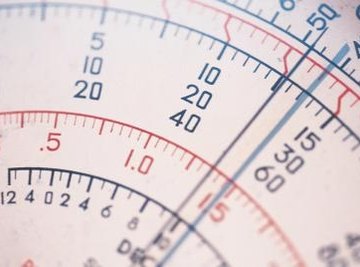
The ohm meter is one of the most basic pieces of electronic test equipment. It is often a range of settings on a multimeter (volt-ohm-milliammeter or VOM) as the ohm meter is a variation on the ampmeter, which measures small electrical current. There are two main types of ohm meter: the D'Arsonval type, with a needle swinging across a ruled meter face; and the digital multimeter (DMM) type, where the value is typically displayed on a liquid crystal display (LCD). The older-style D'Arsonval VOMs are still available. The DMM types are commonly found for under $5.00 at many electronic and discount hardware stores.
Reading an ohm meter
- Ohm meter (either VOM or DMM)
- Several resistors of different values, such as 10 ohms, 1000 (1K) ohms and 50K ohms
The ohm meter is measuring the resistance by measuring the current passing through the tested device between the meter leads. This must be done in an unpowered circuit. Measuring resistance in a powered circuit will measure both the meter's applied voltage and the current in the circuit. At best, this will give an inaccurate reading; at worst, it will damage your meter.
The ohm meter will have two leads, usually a red and a black. Since measuring resistance is done on an unpowered circuit, the polarity (which lead is attached to which end of the device or circuit being measured) will not matter. As you are measuring loose resistors, you may clip one lead to either end of the resistor. If your meter has probes (metal posts rather than clips), press a probe, making firm contact, to each lead of the resistor, or wrap a resistor lead around the probe. There must be a good mechanical connection.
Set the ohm meter range by first turning on the ohm meter, usually via a switch on the front or side of the meter. Then turn the dial on the front of the meter to the ohm range, which is sometimes denoted by the Greek letter Capital Omega, a horseshoe-shaped letter. If you do not know the general range of the resistor you are checking, start at the highest setting, usually in the megohm (a capital M on the dial) range and stepping down until you see a reading on the display.
If you are using a VOM or ohm meter with the needle display, the needle will swing to a point away from the ends. If the needle is near one end or the other, switch to a different range until you are reading more in the middle 80 percent of the full range. Most D'Arsonval displays have a reflective arc under the numbers of the scale. Position the meter or move your head until you are looking straight on to the scale; you should see only the needle. If you see the reflection of the needle, you are still at a slight angle and will not see the exact position of the needle along the scale. When looking straight at the display, read the position of the needle along the scale. There will usually be several different scales, one to correspond with the range (1 ohm, 1K ohm, 100K ohm, 1M ohm) to which you have set the meter. Be sure you are reading the position of the needle against the correct scale. The needle will point to the resistance of your test resistor.
If you are using a DMM, you'll find it easier to understand the readout. It will be in ohms, K ohms or M ohms. If you have set the scale where the upper end of the range is below the resistor value, you will see either a flashing display or sometimes OL for "over limit." Turn to a higher scale until you get a good reading.
Repeat the measurements with your other test resistors. Learning to read a D'Arsonval display takes practice, but can easily be done.
Things You'll Need
Warnings
References
Warnings
- The ohm meter is measuring the resistance by measuring the current passing through the tested device between the meter leads. This must be done in an unpowered circuit. Measuring resistance in a powered circuit will measure both the meter's applied voltage and the current in the circuit. At best, this will give an inaccurate reading; at worst, it will damage your meter.
About the Author
Chris Donahue is an electrical engineer living in the Dallas area. He has worked on defense projects, semiconductor process equipment, instrumentation and is currently in water utilities. He earned his Registered Massage Therapist (RMT) standing in Texas in 1999.
Photo Credits
Ablestock.com/AbleStock.com/Getty Images