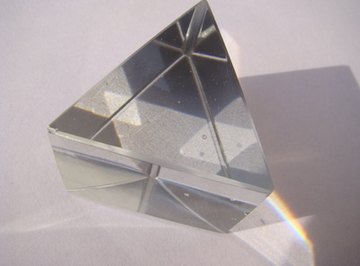
When light rays pass from air into water, they bend, because the index of refraction of air is different from the index of refraction of water. In other words, light rays travel at a different speed in air than they do in water. Snell's law describes this phenomenon, providing a mathematical relationship between the light ray's angle of incidence relative to a perpendicular line running through the water, the refractive indexes of both materials through which the light travels, and the refractive angle at which the light travels through water.
The greater the index of refraction, the more the light bends. Sugar water is denser than plain water, so sugar water has a higher index of refraction than plain water. Here, we will use the physics of refraction to measure the sugar content of water.
Make a Hollow Prism from Microscope Slides
Use epoxy to glue together the edges of four microscope slides to make a rectangular prism.
Place the prism on top of a fifth rectangular microscope slide, and glue the prism to the slide using epoxy.
Allow the epoxy to set overnight.
Measure the Index of Refraction of the Sugar Water
- 5 microscope slides, 1-inch by 3-inch
- Epoxy
- Paper
- Tape
- Laser pointer
- Electrical tape
- Calculator with trigonometric functions
- Tape measure
- Pencil
- Sugar
- Water
Even minimum-power lasers can cause eye damage. Familiarize yourself with safe laser use before attempting this experiment.
Set up for experimentation. Cover a wall with paper to make markings on. Set up the laser pointer so that its beam is perpendicular to the wall. Fix the laser pointer in place and check it periodically to ensure that its beam consistently hits the same spot when passing through air.
Aim the laser beam perpendicularly through the prism when it is empty. When the prism is empty, the beam should not be diverted. Mark the spot where the laser beam hits on the wall. Place a piece of paper underneath the laser and mark the point at which the beam entered the prism (the two spots, together, should form a straight line).
Fill the prism with liquid. Aim the laser beam through the liquid-filled prism. The beam will hit the wall some distance from the original mark. Mark the beam. Measure the distance between these two spots, distance A. Measure the distance from the prism to the wall, distance B.
With the two distances that you measured in Step 3, you can calculate the angle at which the beam hit the wall -- in other words, its angle of refraction after passing through the prism. Calculate this angle by finding the inverse tangent of (distance A divided by distance B).
Use Snell's law, along with the angle that you calculated in Step 4, to determine the index of refraction of your liquid. According to Snell's law, the relative index of refraction of two materials, or n2/n1 (n2 = index of refraction of the second material, n1 = index of refraction of the first material) is equal to the sine of the angle of incidence, divided by the sine of the angle of refraction. You are aiming your laser pointer perpendicular to the prism, so your angle of incidence is 90. You calculated your angle of refraction in Step 4. And finally, the index of refraction of air (n1) is 1.0003.
Create 1 percent, 5 percent, 10 percent, and 50 percent solutions of sugar. Repeat Steps 3 through 5 to determine their indexes of refraction. Graph the sugar concentration versus the angle of refraction. Compare your indexes of refraction for known concentrations to the index of refraction that you calculated in Step 5. Estimate the sugar concentration for your unknown solution.
Things You'll Need
Warnings
References
Warnings
- Even minimum-power lasers can cause eye damage. Familiarize yourself with safe laser use before attempting this experiment.
About the Author
Tricia Lobo has been writing since 2006. Her biomedical engineering research, "Biocompatible and pH sensitive PLGA encapsulated MnO nanocrystals for molecular and cellular MRI," was accepted in 2010 for publication in the journal "Nanoletters." Lobo earned her Bachelor of Science in biomedical engineering, with distinction, from Yale in 2010.
Photo Credits
prism image by ANKUR from Fotolia.com