
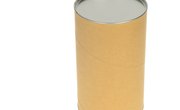
Cans, drums, and pipes are common cylinders. To find the surface area of one of these items, you'll need to know how to find the surface area of a cylinder. A cylinder is composed of three faces -- a circular top and bottom, and a rectangular side. You can find total surface area of the cylinder by adding up the area of these three faces.
Parts of a Cylinder
To find the surface area of a cylinder, you'll need to consider what parts make up a cylinder. First, a cylinder has a top and bottom which are both circles of equal area. Call the area of one of these circles the base area of the cylinder. Then there is the side of the cylinder, which is a rectangle that wraps around its outside to make the surface. This is called the lateral area of the cylinder. Since the cylinder has two circular sides and one rectangular side, its surface area, SA for short, is equal to two base areas plus one lateral area: SA = (2 x base area) + lateral area
Base Area
Because the top and bottom of a cylinder are circles, you can use the formula for an area of a circle to find their area. The area of one of these circles is equal to the cylinder's radius, or r, squared and multiplied by pi. So: base area = pi x r^2. Pi is a constant with an infinite number of decimal places, but you can use 3.14 as an approximation for pi in most equations. Say your cylinder has a radius of 2 inches. To find the base area, you'd multiple pi times 2 squared: base area = pi x 2 inches ^2 = 3.14 x 2 inches x 2 inches = 12.56 square inches
Lateral Area
The lateral surface area of a cylinder is a rectangle with area equal to the height of the cylinder times the cylinder's circumference. Circumference is the distance around the edge of the cylinder, and is equal to the radius of the cylinder multiplied by pi times 2. So the lateral area can be given as: lateral area = h x circumference = h x 2 x pi x r To find the lateral area of a cylinder with height of 3 inches and radius of 1 inch, you'd multiply 3 times 1 times 2 times pi: lateral area = 3 inches x 2 x 3.14 x 1 inch = 18.84 square inches
Total Surface Area
You can combine the formulas for the base area and lateral area into the equation for the calculation for surface area: SA = (2 x pi x r^2) + (h x 2 x pi x r). For example, given a cylinder with height of 4 inches and radius of 3 inches, you would plug in 3 in place of r and 4 in place of h: SA = (2 x 3.14 x 3 inches x 3 inches) + (4 inches x 2 x 3.14 x 3 inches) = 56.52 square inches + 75.36 square inches = 131.88 square inches
References
About the Author
Jon Zamboni began writing professionally in 2010. He has previously written for The Spiritual Herald, an urban health care and religious issues newspaper based in New York City, and online music magazine eBurban. Zamboni has a Bachelor of Arts in religious studies from Wesleyan University.
Photo Credits
TongRo Images/TongRo Images/Getty Images