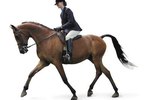
Dressage is the art of training a horse so that he is flexible, balanced, and obedient to the rider. Dressage horses must demonstrate willingness, impulsion and smoothness at all gaits tested. Training the young dressage horse begins with ground work on the lunge line followed by many hours of practice in a riding arena.
Lunging
Begin working your horse in short 10 to 20-minute increments on the lunge line. Ask your horse to walk, trot, canter and halt on a 20-meter circle on the lunge line. Use consistent voice commands to help him understand what you want him to do. Allow him to stretch and move naturally as you help him build up his muscles. Familiarize yourself with your horse's gaits, and take note of areas where he may need additional training.
Contact
Begin dressage training with light contact, using the lightest possible touch on the reins to guide your horse. Ride with a slightly loose rein and a light hand. As your horse progresses, gradually take up more contact. It's important for the rider to have an independent seat and hand so that the contact remains light. Riders that hang onto the reins can hurt the horse's mouth and create tension, the opposite of what dressage training should achieve. Develop your seat by riding without stirrups for 10-minute increments, especially at the sitting trot. This will help you learn how to sit deep and centered in the saddle.
Rhythm
A steady, consistent rhythm is an important aspect of dressage. Horses shouldn't speed up or slow down during a dressage test. Practice rhythm by warming up your horse at all three gaits, then riding him at the trot around a riding ring or arena. On the short rails, sit the trot or take your two point position. On the long rails, pick up a posting trot. Try to do this exercise without speeding up or slowing down your horse's trot. When you can keep the trot consistent and regular, your horse has achieve a good rhythm.
Suppleness
Suppleness and responsiveness to the rider's aids are important aspects of riding circles, serpentines and other dressage movements. Use traffic cones or a jump standard placed in the middle of the riding ring. Practice riding 20-meter circles around the cones or standard, bending your horse around your inside leg and turning his nose slightly towards the center of the circle. Ride half circles and progress into the serpentine, always working on having your horse bend around your inner leg on the circle and changing direction frequently. Try to ride in equal amounts in both counterclockwise and clockwise directions so you don't strain your horse's muscles on one side of the body.
References
Photo Credits
-
Jupiterimages/Brand X Pictures/Getty Images
Writer Bio
Jeanne Grunert has been a writer since 1990. Covering business, marketing, gardening and health topics, her work has appeared in the "Chicken Soup for the Soul" books, "Horse Illustrated" and many national publications. Grunert earned her Master of Arts in writing from Queens College and a Master of Science in direct and interactive marketing from New York University.