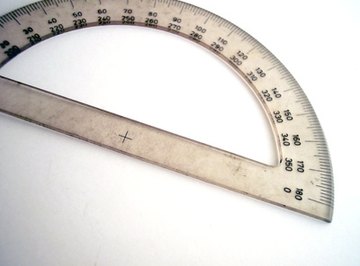

A protractor is a tool that allows you to measure an angle or construct an angle of a given measure.
To Measure an Angle
Find the center hole on the straight edge of the protractor.
Place the hole over the vertex, or point, of the angle you wish to measure.
Line up the zero on the straight edge of the protractor with one of the sides of the angle.
Find the point where the second side of the angle intersects the curved edge of the protractor.
Read the number that is written on the protractor at the point of intersection. This is the measure of the angle in degrees.
To Construct an Angle
- Protractors
- Notebook Papers
- Pencils And Erasers
There are 360 degrees in a circle. A straight line measures 180 degrees. The corner of a square measures 90 degrees. This is called a right angle. Angles that measure fewer than 90 degrees are called acute angles. Those measuring more than 90 degrees are called obtuse angles.
Use the straight edge of the protractor to draw a straight line. This line will form one side of your angle.
Find the center hole on the straight edge of the protractor.
Place the hole over one end point of the line you have drawn.
Line up the zero on the straight edge of the protractor with the line.
Make a mark at the number on the curved edge of the protractor that corresponds to the desired measure of your angle. For example, mark at 90 for a 90-degree angle.
Use the straight edge of the protractor to connect the mark to the end point of the first line, forming an angle.
Things You'll Need
Tips
Tips
- There are 360 degrees in a circle.
- A straight line measures 180 degrees.
- The corner of a square measures 90 degrees. This is called a right angle.
- Angles that measure fewer than 90 degrees are called acute angles. Those measuring more than 90 degrees are called obtuse angles.
About the Author
This article was written by the CareerTrend team, copy edited and fact checked through a multi-point auditing system, in efforts to ensure our readers only receive the best information. To submit your questions or ideas, or to simply learn more about CareerTrend, contact us [here](http://careertrend.com/about-us).
Photo Credits
protractor image by timur1970 from Fotolia.com