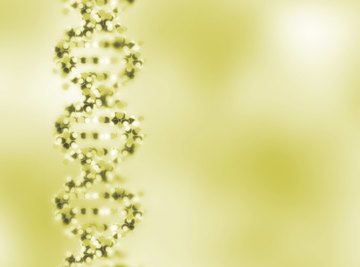

Models for academic or demonstration purposes become much more useful when properly labeled. Labels need to be accurate, understandable and legible.
The more complex the model, the more important proper labeling becomes. A DNA model labeled properly represents one of the most complex structures of life while appearing elegantly simple.
DNA Structure
The deoxyribonucleic acid (DNA) structure looks like a twisted ladder made of six different parts. The sides of the ladder consist of two parts, a five-carbon sugar called deoxyribose and a phosphate molecule.
The rungs of the ladder form from pairs of nitrogenous bases. Adenine and thymine form one pair while cytosine and guanine form the other pair.
Due to their chemical structures, these bases combine only in these pairs. If each base is shown in a different color, such as yellow for adenine and blue for thymine, the viewer will find the model much easier to understand.
(See Resources to practice constructing a DNA model.)
Hydrogen bonds hold the nitrogenous base pairs together but let the pairs separate when the DNA molecule replicates. Depending on the project instructions, these hydrogen bonds may or may not be shown. If required, the hydrogen bond in DNA models could be shown using toothpicks or small magnets as connectors or represented with glitter or glitter glue.
Labeling the Project
Labels must be legible. Fancy or elaborate fonts make the labels more challenging to read and understand, so use simple fonts that are easy to read. Also, use an appropriately sized font. The greater the distance of the viewer from the model, the larger the font size needs to be.
Labels should include enough information that the model is understandable by itself. Using the same or very similar format for all labels aids understanding as well.
Labeling the DNA Molecule Project
Once constructed, label the DNA model and its parts clearly and accurately. Short explanations and definitions will greatly enhance the project.
The DNA model should have a larger label because this is the name of the complete structure. Additional information that might be required includes the name of the model maker, the date of construction or due date, the instructor's name and the class title.
An explanation of the DNA molecule project might also be required. A paragraph explanation will most likely require at least a description of the double helix structure and a short discussion of the significance of the DNA molecule.
The instructions might also require the names of the discoverers of the structure (Crick and Watson with the help of x-ray diffraction pictures taken by Rosalind Franklin and Maurice Wilkins). Follow the project directions.
Label the phosphate molecule: Phosphate molecules consist of a phosphate atom surrounded by four oxygen atoms. The phosphate molecules form the links along the rails or sides of the DNA molecule. The twist in the DNA structure comes in part from these molecules.
Label the deoxyribose molecule: The second part of the rails or sides of the DNA twisted ladder is the deoxyribose molecule. Deoxyribose is a five-sugar molecule called ribose that has lost an oxygen atom (deoxy-). This molecule connects to the nitrogenous base cross links, or rungs, of the DNA ladder.
Label the base pairs: Each rung on the DNA ladder consists of one base pair, either adenine and thymine or guanine and cytosine. The chemical structures of these four nitrogenous bases prevent any other combinations. If the directions require the bases to show relative size, adenine and guanine are slightly larger molecules.
Adenine and thymine: Standard practice permits labeling adenine as A and thymine as T, but the model must have at least one rung labeled with the full names and letter designations.
For example, one nitrogenous base of adenine should be labeled Adenine (A), and the attached nitrogenous base of thymine should be labeled Thymine (T). If these labels are clearly presented, the rest of the adenine bases may be marked with an A label and the partner thymine can be marked with T. Again, check the directions.
Guanine and cytosine: Standard practice permits labeling guanine as G and cytosine as C, but the model must have at least one rung labeled with the full names and letter designations.
For example, one nitrogenous base of guanine should be labeled Guanine (G) and the attached nitrogenous base of cytosine should be labeled Cytosine (C). If the teacher agrees, the rest of the guanine bases can be marked with G, and the cytosine bases can be marked with C.
Hydrogen Bonds in the DNA Model
If the model requirements include showing the hydrogen bond, carefully mark the locations of the hydrogen bonds between the adenine and thymine bases as well as between the guanine and cytosine bases.
If the label cannot be placed exactly on the hydrogen bond location(s), then place as close as possible. Arrows, if used, should cross as little of the model as possible.
Identify a nucleotide: A nucleotide consists of a group containing one phosphate molecule, one deoxyribose molecule and one nitrogenous base. A label identifying one nucleotide should clearly show the three connected molecules as a group.
Arrows, strings or identifying markers like matching star stickers could be used to connect the three parts of the nucleotide to the label.
References
About the Author
Karen earned her Bachelor of Science in geology. She worked as a geologist for ten years before returning to school to earn her multiple subject teaching credential. Karen taught middle school science for over two decades, earning her Master of Arts in Science Education (emphasis in 5-12 geosciences) along the way. Karen now designs and teaches science and STEAM classes.
Photo Credits
Thomas Northcut/Lifesize/Getty Images