
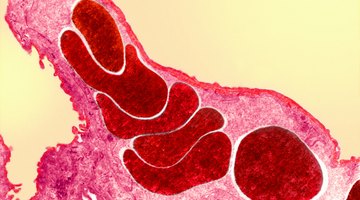


With each breath, your lungs pump oxygen into the bloodstream and remove carbon dioxide. Why does oxygen get its own organ system? This is especially puzzling because oxygen can transform cellular molecules into toxic compounds. That oxidation power, it turns out, is exactly why our cells need oxygen to function efficiently. This “tiny gas molecule” enables the final portion of cellular aerobic respiration.
Oxygen, a Potent Oxidizer
Oxygen is not directly required by any of the enzymes involved in glucose metabolism. Where, then, is it needed? When glucose -- a highly reduced compound -- is oxidized, electrons are passed from the sugar to carrier molecules to the electron transport chain where oxygen, a powerful oxidizer, plays a key role. It takes the electron from the electron transport chain, becoming water in the process. The electron transport chain produces large amounts of cellular energy, which means oxygen is directly related to cellular respiration and energy production. To better understand this process, however, we will need to dig a bit deeper into oxidation and reduction reactions.
Oxidation and Reduction
A molecule’s oxidation state is the theoretical charge it would have if all covalent bonds were instead ionic bonds. If a molecule is oxidized, that number becomes more positive. A reduction, on the other hand, causes the number to be more negative. A simplified explanation is that electrons are transferred away from an oxidized compound, while they are transferred to a reduced compound. An oxidizing agent accepts electrons in order to oxidize another compound, while a reducing agent passes electrons to other compounds. Oxidation and reduction reactions sometimes rearrange the chemical form of compounds because positive hydrogen ions tend to accompany electrons through reactions. Now we can look more closely at the glucose metabolism process to further see why oxygen is so important.
Glucose Metabolism Process
When a glucose molecule enters the cell, it is broken down into energy in three major steps. First, the 6-carbon ring is converted by glycolysis into two 3-carbon chain pyruvate molecules. Next, pyruvate enters the Krebs cycle, where it is further broken down into carbon dioxide. During the metabolism process, electrons are passed to the oxidizing agents nicotinamide adenine dinucleotide, or NAD, and flavin adenine dinucleotide, or FAD, to form NADH and FADH2. Finally, NAD and FAD pass the electrons to the electron transport chain embedded in the inner mitochondrial membrane. Molecular complexes in the chain use an electron’s energy to move protons through the mitochondria's inner membrane. High-energy adenosine triphosphate, or ATP, is produced when the protons diffuse back through ATP synthase proteins in the membrane.
What Happens When No Oxygen is Available?
Cells can rapidly run low on oxygen during heavy exercise. Without the proper oxidizing agent, the electron transport chain cannot function, which means that the cell cannot recycle NAD+ and FAD+. Without the required electron carriers, the Krebs cycle grinds to a halt. If the cell had no backup plan to regenerate NAD+, glycolysis would also cease, and the cell would rapidly die. The method of removing the electron from NADH in the absence of oxygen is to pass the electron to pyruvate, the end product of glycolysis, to form lactic acid. This method only nets 2 ATP molecules -- by comparison, the full three-step metabolism process described earlier results in a gain of 36 to 38 ATP molecules.
Related Articles





References
- Georgia State University; HyperPhysics; Glycolysis; Carl Rod Nave
- NobelPrize.org; The citric acid cycle Nobel Lecture; Hans A. Krebs; December 11, 1953
- National Science Teachers Association; Electron Transport System; June B. Steinberg; 2000
- "Human Anatomy and Physiology"; Elaine N. Marieb; 2012
- "Pharmacy Admission Test Review"; Kaplan Publishing; 2012
- "Molecular Cell Biology"; W. H. Freeman and Company; 2000
Resources
Writer Bio
Robert Mullis is is a graduate of Liberty University with a bachelor's degree in biochemistry and a second degree in accounting. As a writer, he specialized in math, biology, chemistry, literature, and business.