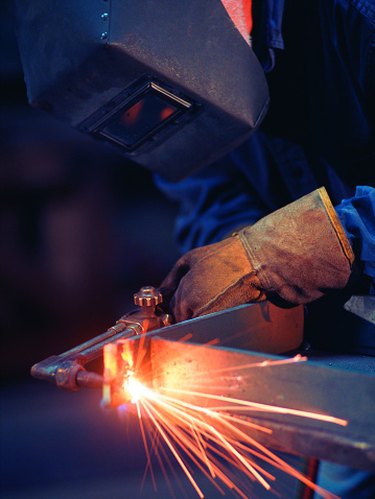
How to Weld Cast Iron to Steel

How to Weld Cast Iron to Steel thumbnail
Welding cast iron and steel is essentially similar.

Welding cast iron to steel is a process that really doesn't take much time to get the hang of, even if you've never welded before. The reason for this is that steel is slightly harder than cast iron, and therefore combines fairly easily. The most difficult aspect of welding is when the cast iron is relatively small or thin compared to the steel; because cast iron is softer and has a lower melting point, it is easy to burn through if you aren't careful.

Things You'll Need

  • Welding helmet
  • Long-sleeved shirt
  • Welding gloves
  • Wire brush
  • MIG welder
Show More

Instructions

    • 1

      Set up your welding workspace, beginning with an overview of the basic safety precautions necessary while welding. Ensure that there are no puddles of standing water in which you might stand, and that there are no flammable materials nearby. For personal protection, use a welding helmet. It is also more comfortable to weld if you wear a long-sleeved shirt and welding gloves.

    • 2

      Turn on the MIG welder and set it to the necessary power you'll need to weld the metals together. A reference chart is usually located just inside the cover of the welder that tells you what power level and wire speed to use for the thickness of steel that you are welding. Measure your metal and set the welder's power and wire speed accordingly.

    • 3

      Position the cast iron and steel in the position that you want them to be welded into, and then extend the welding electrode approximately 1/4 inch from the welding nozzle by pulling the trigger on the welding gun. Clamp the welder's ground clamp onto the workpiece.

    • 4

      Touch the electrode to the steel, not the cast iron, and then pull the trigger. Through your welding helmet, you will see a small pool of molten steel form where the wire touches the steel. While you are pulling the trigger, move the electrode slowly toward the cast iron until the pool of molten metal forms there.

    • 5

      Move the electrode back and forth between the steel and the cast iron in a stitching motion. The molten pool of metal should remain approximately 1/4 inch in diameter. If it grows smaller, slow down how quickly you pass the electrode between the steel and cast iron. If it grows larger, speed up how quickly you move.

    • 6

      Finish the weld and release the welder's trigger. When completed, there will be a crust of slag covering the weld area. Clean away this slag with the wire brush and allow the weld to cool before attempting to handle the metal.

Tips & Warnings

  • You may need to warm the items to be welded.

  • If it needs to be water tight use a sealing compound such as Scotch Weld to complete the process.

  • Always wear a welding helmet when you are using any kind of welder. Not only can you damage your eyesight permanently by not wearing a helmet, but you can also weld the metal together incorrectly, destroying the workpiece.

Related Searches:

References

  • "Welding For Dummies"; Steven Farnsworth; 2010
  • "Welder's Handbook, Revised: A Guide to Plasma Cutting, Oxyacetylene, ARC, MIG and TIG Welding"; Richard Finch; 2007
  • "Welding Manual"; John Haynes; 1995
  • Photo Credit Jupiterimages/Photos.com/Getty Images

Comments

You May Also Like

  • Tips for Welding Steel to Cast Iron

    Tips for Welding Steel to Cast Iron. When arc welding cast iron, it's often necessary to patch holes with mild steel. However,...

  • How to Weld Cast Iron

    Cast iron usually has a carbon content of 2 to 4 percent which is much greater than in most steels. This causes...

  • How to MIG Weld Cast Iron

    Metal inert gas (MIG) welding is a type of welding in which a consumable wire electrode and shielding gas is fed continuously...

  • How to Weld Cast Metal

    Since aluminum is ductile, it can expand and contract without cracking. Consequently, welding an aluminum casting with the right filler metal is...

  • How to Do Cast Steel Welding

    Cast steel tends to crack and wear down when overexposed to high amounts of heat. Cast steel welding is a bit more...

  • Why Do You Heat Cast Iron Before Welding It?

    Cast iron can be very difficult to weld, especially if done improperly. It has a very high carbon content, up to ten...

  • How to Weld Steel

    Steel is a metal alloy that primarily consists of iron and has a carbon content between 0.2 and 2.04 percent. It becomes...

  • How to Gas Weld Cast Iron

    Welding cast iron can be challenging if you do not know the correct process and the properties of the metal. Cast iron...

  • How to Weld Cast Iron Without Cracking

    The problem faced when welding cast iron is the high carbon contest of the steel. This 2 to 4 percent carbon content...

  • How to MIG Weld Cast Iron UTP

    The only UTP product manufactured for cast iron MIG welding is a ferro-nickel MIG wire labeled A8051 Ti. It is used on...

  • How to Weld Cast Iron With a Wire Feed Welder

    Welding on cast iron is a bit different than welding on most other metals. Because of its chemical makeup, cast iron is...

  • How to Weld Galvanized Steel to Carbon Steel

    Galvanized steel and carbon steel contain the same base material, steel. The corrosion-resistant zinc coating that covers galvanized steel is the only...

  • How Do I Weld a Wrought Iron Railing?

    Wrought iron railings can be welded using several techniques. These include: forge welding, resistance welding, oxyacetelene welding, shielded metal arc welding ...

  • How to Stick Weld Cast Iron

    Cast iron is renowned for its strength. Despite this, it occasionally breaks. If you have a leaky cast iron bathtub, or a...

  • How to Weld Cast Aluminum

    If you have a broken piece of cast aluminum outdoor furniture, you may be tempted to throw it away. Cast aluminum is...

  • How to Distinguish Between Cast Iron & Cast Steel

    For welding, pipe fitting, plumbing or other work with metal, you need to be able to tell the difference between cast iron...

  • How to Use the Studding Method to Weld Cast Iron

    Cast iron is difficult to weld because its high carbon content makes it brittle. Welding cast iron typically involves making repairs to...

  • How to Weld Hardened Steel

    Hardened steel is a form of high carbon steel that has been tempered through a heating process to make the metal more...

Related Ads

Featured