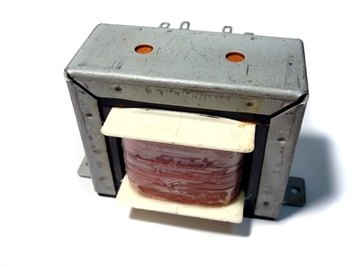

A current transformer is used to measure the current of a circuit into which an ammeter cannot be directly inserted. Transformers consist of two circuits linked with magnetizable material called a “core.” Both circuits have a length that coils around the core, to transmit energy from one circuit to another. In a current transformer, the primary (energy-transmitting) circuit loops through the core only once. The secondary circuit loops several times around the core. The core may be permanently in place around the primary or be hinged to fit around the line.
Solid-core Transformer
- Electrical tape
- Coated copper wire
- Circular iron ring
- Ammeter
So the transformer can be added to a line already in place, a removable core can be made by attaching four soft-iron rods around the line to be measured — the closer the fit, the better. Three rods should be wound beforehand. The fourth need not even be wound, just taped in place to complete the square core.
Coil the copper wire around the iron ring, covering nearly all its surface. The windings can be overlapped or not. The greater the number of windings, the lower the secondary’s current can be made through the secondary, which will protect the delicate ammeter from overheating.
Cover the windings with electrical tape to hold them in place.
Strip the coating off the ends of the wire.
Attach the bare wire ends to an ammeter.
Insert a line of known voltage into the iron ring. Use the measurement on the ammeter to determine a conversion factor, so that the current of future primaries can be determined from the secondary’s ammeter reading.
Insert the line to be tested through the ring. The ammeter need not be attached to the ammeter all the time. The transformer ring can be left in place permanently.
Things You'll Need
Tips
References
Tips
- So the transformer can be added to a line already in place, a removable core can be made by attaching four soft-iron rods around the line to be measured --- the closer the fit, the better. Three rods should be wound beforehand. The fourth need not even be wound, just taped in place to complete the square core.
About the Author
Paul Dohrman's academic background is in physics and economics. He has professional experience as an educator, mortgage consultant, and casualty actuary. His interests include development economics, technology-based charities, and angel investing.
Photo Credits
transformateur électrique image by Lounatiq from Fotolia.com