What does fact checked mean?
At Healthfully, we strive to deliver objective content that is accurate and up-to-date. Our team periodically reviews articles in order to ensure content quality. The sources cited below consist of evidence from peer-reviewed journals, prominent medical organizations, academic associations, and government data.
The information contained on this site is for informational purposes only, and should not be used as a substitute for the advice of a professional health care provider. Please check with the appropriate physician regarding health questions and concerns. Although we strive to deliver accurate and up-to-date information, no guarantee to that effect is made.
Can You Get Scabies From Playing in the Dirt?
The itchy rash on your skin could be caused by scabies---also known as the "human itch mite." Scabies can infest anyone, regardless of age, race, gender or social standing 1. But there are numerous misconceptions about how the scabies mite infests humans 1.
If you are experiencing serious medical symptoms, seek emergency treatment immediately.
Do You Get Scabies From Playing in the Dirt?
The simple answer is no. Scabies must have a human host to survive 1. The female mite lays eggs under the skin in serpentine burrows, usually where skin touches, for example, the crooks of the elbows or finger webbing. Scabies won't live long away from humans--according to the Centers for Disease Control, around 72 hours 1.
Where Do Scabies Live?
How to Get Rid of Mites on a Human
Learn More
Scabies live on other people 1. All it takes is one impregnated female scabies mite to cause a human infestation 1. You may not show symptoms for four to six weeks after you get scabies 1.
Getting Scabies
To get scabies, you must have sustained physical contact with someone with scabies 1. Children can get scabies from playmates 1. When adults get scabies, most of the time, it's through sexual contact 1.
Are Some People More At Risk for Scabies?
Early Scabies
Learn More
Infestations are more common in places where people are in close proximity, says the CDC, such as prisons, extended-care facilities and day care centers.
Getting Rid of Scabies
See a doctor to diagnose your condition and prescribe a topical lotion called a scabicide to kill the mites on your skin.
Where Else Scabies Live
Scabies can linger in clothing, linens, and towels 1. The CDC recommends laundering everything two to three days prior to treatment.
Related Articles

How to Get Rid of Mites on a Human
Learn More
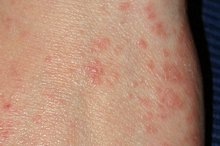
Early Scabies
Learn More
How to Get Rid of Sarcoptic Mange in People
Learn More

Itchy Skin Between the Toes
Learn More
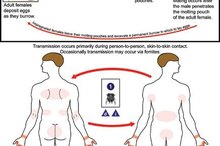
Mange Treatment for Humans
Learn More
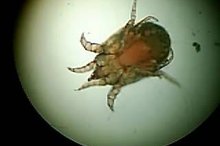
How Long Can Scabies Eggs Live?
Learn More

What Are Skin Symptoms of Mites?
Learn More
What Happens If Scabies Goes Untreated?
Learn More
How to Tell If a Human Has Ear Mites
Learn More

Causes of Tiny, Red Bumps on Fingers
Learn More
References
- CDC: Scabies
- Mayo Clinic: Scabies Causes
- Scabies. World Health Organization.. May 20, 2019.
- CDC - Scabies - Disease. Centers for Disease Control and Prevention. Nov 2, 2010.
- Harvard Health Publishing. Scabies. Harvard Health. Dec 2018.
- Mrázová Z, Jadrníčková I, Brabcová K, Spurný F. Fragmentation of Ne ions with energy 400 MeV/u behind targets from different materials measured with PNTD. Radiation Measurements. 2010;45(10):1438-1440. doi:10.1016/j.radmeas.2010.06.048.
- Patel VM, Lambert WC, Schwartz RA. Safety of Topical Medications for Scabies and Lice in Pregnancy. Indian J Dermatol. 2016;61(6):583-587. doi:10.4103/0019-5154.193659
- CDC - Scabies - Resources for Health Professionals - Medications. Centers for Disease Control and Prevention. Oct 2, 2019.
- CDC - Scabies - General Information - Frequently Asked Questions (FAQs). Centers for Disease Control and Prevention. Oct 24, 2018.
- Arlian LG, Morgan MS. A review of Sarcoptes scabiei: past, present and future. Parasit Vectors. 2017 Jun 20;10(1):297. doi: 10.1186/s13071-017-2234-1.
- CDC. Scabies. Resources for Health Professionals, Medications.
- Micali G, Lacarrubba F, Verzì AE, Chosidow O, Schwartz RA. Scabies: Advances in Noninvasive Diagnosis. PLoS Negl Trop Dis. 2016 Jun 16;10(6):e0004691. doi: 10.1371/journal.pntd.0004691. eCollection 2016 Jun.
Writer Bio
Lisa Sefcik has been writing professionally since 1987. Her subject matter includes pet care, travel, consumer reviews, classical music and entertainment. She's worked as a policy analyst, news reporter and freelance writer/columnist for Cox Publications and numerous national print publications. Sefcik holds a paralegal certification as well as degrees in journalism and piano performance from the University of Texas at Austin.