What Is a Pelvic CT Scan?
A pelvic CT scan is a diagnostic test that doctors use to discover potential medical problems. In men, the pelvic CT scan can reveal troubles with the prostate gland and the seminal vesicles--the glands that produce semen. In women, a pelvic CT scan can check the uterus, ovaries and fallopian tubes for anything wrong. CT itself stands for computed topography, and the procedure combines X-rays and computers to produce an image of the interior of the body.
Features
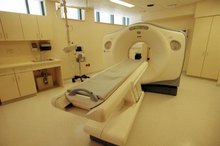
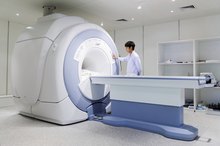
A typical CT scanner is a machine resembling a large box with a tunnel in the center of it. The patient lies on an examination table that slides in and out of the tunnel. X-ray tubes and X-ray detectors rotate about the patient while the computer that processes the image is in a separate room altogether, complete with a monitor and a technician who operates the machinery and closely monitors the pelvic CT scan.
Function
Allergic Reaction to Barium Sulfate
Learn More
The pelvic CT scan works like other CT scans. The X-rays and electronic X-ray detectors spin around you as the exam table with you on it moves through the machine. A computer program creates a two-dimensional cross-section picture of your pelvic region, which the technician views on a monitor. The computer actually takes many pictures of slices of your body and then reassembles them into a picture.
Time Frame
The CT scan of the pelvic region requires that the patient drink no less than 2 cups of what is known as contrast material. This material contains iodine, which helps produce much sharper pictures of the area being scanned. You will need to drink the contrast material at least an hour before the CT scan, and then you will drink at least one more cup right before the scan. In some cases, a contrast material enema is given while you are actually on the exam table; this procedure allows a better view of the rectum and colon. The ingestion of the contrast material is often the most unpleasant part of a pelvic CT scan, which normally takes 30 minutes or less to complete.
Misconceptions
Why Is Creatine Level Important for a Brain MRI?
Learn More
A pelvic CT scan is a pain-free experience and very accurate. Bones, soft tissues and blood vessels can all be imaged at once, and a CT scan is not as sensitive to the potential movement of a patient as other procedures. Patients with implants can receive a pelvic CT scan, and no radiation stays inside the patient's body afterward. This type of scan can quickly reveal what's wrong in many instances and allow a diagnosis to be made.
Expert Insight
It is a good idea to wear clothing such as sweatpants and T-shirts to a pelvic CT scan. They do not contain metal such as buttons or zippers, meaning most of the time you will not have to change into a hospital gown. Leave your jewelry at home, and objects such as glasses and dentures must be removed before the scan. You cannot eat or drink for many hours before a pelvic CT scan, and if you have any medical conditions that could interact with the contrast material, you must let the technician know. The best way to drink the contrast material, if there is one, is to do so all at once.
Related Articles

Allergic Reaction to Barium Sulfate
Learn More

Why Is Creatine Level Important for a Brain MRI?
Learn More

How to Drink Barium Sulfate Contrast Suspensions for CT Scans
Learn More

Advantages & Disadvantages of a CAT Scan
Learn More
Advantages & Disadvantages of CT Scans
Learn More
How to Prepare for a Bone Density Scan
Learn More
What Does a Pinched Nerve MRI Look Like?
Learn More

How to Administer an Enema With a Bulb Syringe
Learn More

Aphasia Speech Therapy Activities
Learn More
A Clear Liquid Diet Before a CT Scan
Learn More
Resources
Writer Bio
John Lindell has written articles for "The Greyhound Review" and various other online publications. A Connecticut native, his work specializes in sports, fishing and nature. Lindell worked in greyhound racing for 25 years.