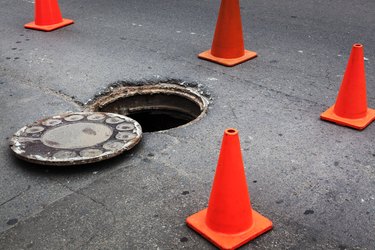
People often underestimate how heavy a manhole is. It rattles when we drive over it, so it should be pretty easy to dislodge and lift, right? Wrong. Manholes are generally made of cast iron and are extremely heavy. Removing one improperly can be very dangerous to the back and spinal column if proper precautions are not taken.
Manhole Cover Hook
Video of the Day
Using a manhole cover hook to remove a manhole cover is probably the most practical approach since you're a using a tool specifically designed for this use. Manhole cover hooks are available at home improvement stores like Home Depot or Lowe's. Manhole cover hooks, also known as manhole keys, come in a variety of sizes and styles. Make sure that you have the correct sort of hook for the manhole cover you are trying to remove. Using the wrong hook will get you nowhere.
Video of the Day
After acquiring the correct manhole cover hook or key, make sure that the area around the manhole cover is clear of dirt, debris or mud that can bind the manhole cover to the hole itself, making it difficult to dislodge.
Once the perimeter is clear, hook the manhole key into the manhole cover, straddle the manhole cover and lift with your back straight and your knees bent. This is very important: Back injuries can happen when you lift using your back and not your legs.
Additional Tools
While manhole cover keys are the most highly recommended way to dislodge and remove a manhole cover, there are other ways to complete this task. However, it's very important to exercise caution when removing a manhole cover with ancillary tools that are not specifically designed to leverage the weight of a manhole cover. Crowbars can be used to prise open manhole covers if you are ultimately planning to lift the cover with your hands, but cannot be used to lift the manhole covers themselves. If you plan to lift the manhole cover with your hands, be sure that you're wearing heavy duty gloves to protect your hands from scrapes, cuts and the rough sides of the manhole cover.
Screwdrivers can also be used as prising tools to help loosen the manhole cover from its ring, but should not be used to lift the manhole cover.
Can Manhole Covers Fall Into Their Holes?
A common worry about lifting a manhole cover is that the manhole cover will slip out of your grip and go tumbling into the hole. However, this is impossible: Manhole covers can't fall into manholes because both the hole and the cover are round. Underneath the manhole cover is a small lip that is smaller in circumference than a manhole cover, and the manhole cover itself, even turned on its side cannot slip through.