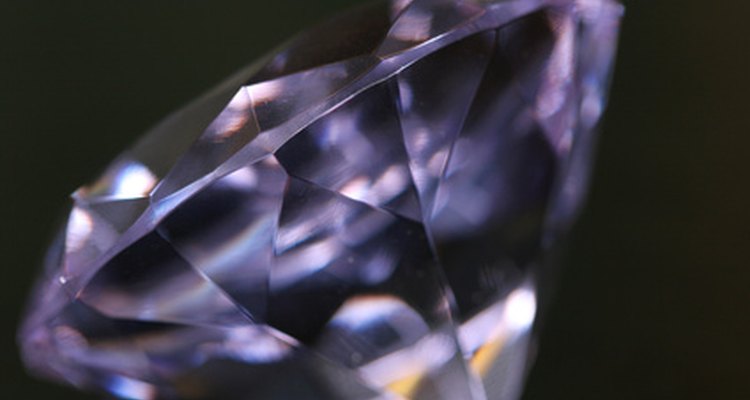
When choosing a diamond there are several considerations that come into play. The majority of stones you'll find in local retailers are commercial grade diamonds, which make up a strong percentage of the diamond market. Commercial grade diamonds are ranked on clarity, color, cut and carat--the four Cs--and are generally much more affordable than noncommercial grades, which score higher in all the categories.
Commercial Grade Diamonds
Commercial grade stones are more affordable but are lower in quality. According to Diamond Cutters International, the 2008 distribution of commercial to noncommercial diamonds was 49 to 1. The average resale value of a commercial grade stone is 19.7 percent of the original price paid. Commercial grade diamonds are primarily ranked on clarity and color.
Clarity
A diamond’s clarity is graded on inclusions, cracks and debris found in a diamond. Flawless diamonds are the highest grade and have no blemishes inside or on the surface of the diamond. The next highest grades are “VVS”--very, very, slightly imperfect--and “VS”--very slightly imperfect. Commercial grade diamonds fall in the next two categories--”SI,” small inclusions, and “I”, imperfect. “I” is at the very bottom of the clarity scale. Diamonds with clarity “SI” and “I” are much cheaper than higher grades.
Color
Diamonds come in a variety of colors but are most popular in the white range. The Gemological Institute of America rates diamonds on a scale from “D” (colorless) to “Z” (yellow tint). Colorless diamonds, ranging from “D”, “E” and “F”, cost more and are the highest color grade. Commercial grade diamonds would fall in the near colorless or faint yellow ranking.
Cut
The cut of a diamond refers to the proportions of the body opposed to the shape. The most expensive and sought-after diamonds are cut and polished to allow the maximum amount of light to enter, reflect and disperse back through its top. If a stone is cut too shallow or too deep, light does not reflect correctly and the stone doesn't have as much vibrancy.
Carat
The carat of a diamond is its weight. The bigger the carat weight, the more expensive the diamond. A 1 carat diamond is 100 points. Therefore a 1/2 carat diamond would be 50 points. Two diamonds can be the same carat weight but have different costs due to the grade of the cut, color and clarity.
Related Articles

How Valuable Is a Garnet in Carats?

How to Tell If a Gem Is a Kunzite?
The Differences Between Emerald Cut & ...

Tanzanite Vs. Diamonds

Strontium Titanate Vs. Diamond
Information on African Rubies

Cubic Zirconia Vs. White Spinel

Types of Valuable Crystals
Which Types of Gems Are Most Expensive?
What Is Ceylon Sapphire?
Physical Characteristics of the Ruby ...

Difference Between Manmade & Natural ...
List of the Types of Semi-Precious ...
Kunzite Pricing Guide

What Is 916 in Jewelry?
What Is the Luster of a Diamond?

What is the Value of Black Pearls?

What Is a Pink Amethyst?

Glass Vs. Crystal Rhinestones

What Does VSOP Mean?
References
Writer Bio
Shauna Heathman is a certified image consultant with a passion for writing, and has been writing since 2006. She has maintained a blog of her own for three years in which she writes on topics concerning self development, appearance, style, etiquette and communications. Heathman has a bachelor's degree in communication studies and an entrepreneurship certificate from the University of Iowa.
Photo Credits
diamond image by sumos from Fotolia.com