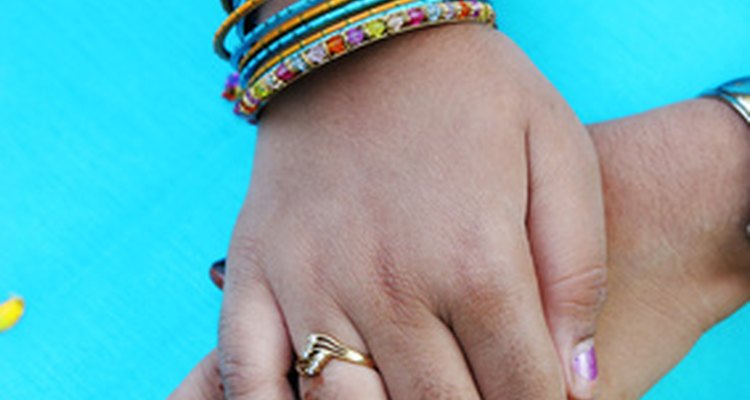
A Malay wedding is a very regal affair. It is divided into two parts: the akad nikah, which is the marriage contract, and the family celebration, which is called the bersanding or the enthronement ceremony. The bride and groom sit like king and queen, dressed in richly decorated attire, feeding each other yellow rice with their hands decorated with henna while their guests join them in celebrating their happy day. Various royal customs are performed for them, including musicians playing court music. The Malay ceremony is based on traditions dating back centuries.
Culture
The Malay are Malaysia's largest ethnic group, accounting for more than 1/2 the population and the national language, but the country consists of a wealth of cultures, including Indian, Chinese and Portuguese. The customs of a Malay wedding ceremony reflect that diversity.
Groom
The groom wears the traditional Malay costume of Baju Melayu, which translates as "Malay shirt" and consists of a long-sleeved shirt and trousers. He wears head wear known as tanjak; it is commonly made from a type of woven silk fabric. He also wears a dagger known as a keris, which is indigenous to Indonesia, Malaysia and Singapore. As he walks with family members to the home of his bride, it is common for the best man to shade him with a gold-colored umbrella accompanied by palm blossom carriers.
Bride
The bride, who stands outside her home to wait for her husband-to-be, wears an embroidered baju kurung, the traditional Malay dress for women. This dress, which is a long-sleeved blouse over a matching sarong, often is well-coordinated with her husband's outfit. The modern version of this dress is the baju kebaya. She also wears a tudung, which is a hijab or headscarf to cover her hair and a selendang, or embroidered and beaded shawl over the tudung. A crown placed on top of the shawl signifies her importance for the day. With flower girls behind her, she walks from her house to meet the groom a few yards from her home.
Henna
The bride's palms and feet are decorated using dye from henna leaves to signify fertility and love. The groom's hands are decorated, too. Hands and feet are chosen for decoration because it is thought that the dye will last longer there. This marriage custom is also common in India, Pakistan, Bangladesh and Morocco. Following this ritual, the bride and groom change attire for photographs.
Guests
It is Malay tradition to have a lot of guests at the wedding. If the ceremony takes place in a village, the whole village is invited. According to an e-Borneo.com article," "the more the merrier" is one of the most "important concepts" at a Malay wedding.
It is appropriate for women guests to wear a long-sleeved dress, and many women cover their head. Men often wear either a business suit or long-sleeved shirt with trousers.
Related Articles
A Guide to Preparation for a Hindu ...

Financial Responsibilities of the ...
Quinceanera Rituals

Italian Wedding Customs & Etiquette

What Is the Meaning of a Ring in the ...

Ideas for an Indian Wedding Anniversary
Hispanic Clothing History
Romanian Orthodox Wedding Traditions
Mexican Wedding Traditions
What Do the English Wear to an Amish ...
Ribbon Meanings for a Handfasting ...
What Does the Corsage Symbolize?

Traditional African Wedding Attire
Mexican Quinceanera Traditions

Traditional Chilean Wedding Attire

Quinceanera Requirements
What Can You Wear for a Hindu ...

Why Do Brides Wear Veils?
How to Dress for a Bris Ceremony

Traditional Iraqi Wedding Gifts
References
Writer Bio
Louise Scrivens is a journalist and editor who started out on newspapers in 1998 and has since traveled around the world working as a writer and editor for BBC News in London, Australian Associated Press and Bloomberg News in New York. She holds a Bachelor of Arts in English language and literature from Salford University, Manchester.
Photo Credits
henna hands image by Gina Smith from Fotolia.com