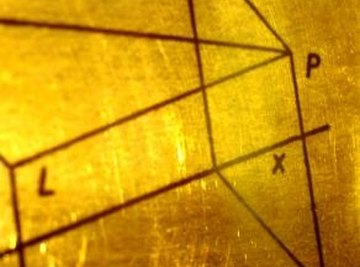
Picture the prism before you calculate its surface area. It has two dimensional faces with areas you could figure out using two dimensional figure area formulas. For example, a triangle prism has three rectangles for its sides, and triangles for its bases. Find the area of all three rectangles and both bases to get that prism's total surface area.
A prism is named after its base's shape. If it has triangle bases, it's a triangular prism. When you see a question asking for triangular prism surface area, know that you're required to figure out a triangle's area as part of the solution.
Use length times width, (l)(w), to calculate a rectangular face on the prism. Multiply the result by the number of faces your prism has. This is all you'd have to do if you're asked to calculate prism lateral area. Lateral area is the prism's sides.
Look at the prism base. Use the formula for a triangle's area if you're working with a triangular prism. Triangle area is (1/2)(b)(h) where "b" is base and "h" is height. Use a square's area formula, square one of the sides, if you're calculating total base surface area for a square prism.
Multiply Step 2's result by two if your prism has two bases. Skip this step if your prism only has one base. Take your results for the total surface area of your prism's sides. Add that result to the total prism base surface area. This gives you the total prism surface area.
Tips
Tips
- A prism is named after its base's shape. If it has triangle bases, it's a triangular prism. When you see a question asking for triangular prism surface area, know that you're required to figure out a triangle's area as part of the solution.
About the Author
This article was written by the CareerTrend team, copy edited and fact checked through a multi-point auditing system, in efforts to ensure our readers only receive the best information. To submit your questions or ideas, or to simply learn more about CareerTrend, contact us [here](http://careertrend.com/about-us).
Photo Credits
Ryan McVay/Photodisc/Getty Images