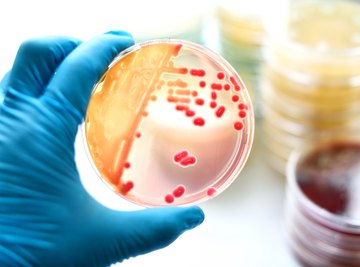
Bacteria are grown in Petri dishes upon a solid medium known as bacterial agar, where raised, circular colonies form. Unlike an individual bacterial cell, a colony is a group of bacteria large enough to be visible to the naked eye. Bacterial growth can be measured by simple observation of how many colonies are present; however, more quantitative methods include the use of a counting chamber, or more often, viable plate counts. The latter is used most frequently as it also provides qualitative information such as the effect of varying growth conditions. Since there might be billions of bacteria in a petri dish, measuring first requires diluting the sample so that it is possible to count the number of colonies.
- Dilution media
- Pipettes and tips
- Tubes
- Bacterial culture media and agar plates
- Vortex
- Bunsen burner
- Glass spreaders
- 70 percent ethanol
Be sure to sterilize the glass spreader by dipping the spreading edge into 70 percent ethanol and inserting it into a Bunsen burner flame. Allow the ethanol to catch fire and slowly burn off the alcohol, which will kill all bacterial contamination. Gently touch it to the dry (that is, no bacteria) part of the agar to cool it - the agar should not melt on contact.
Treat any bacteria as if it is potentially pathogenic, and use proper lab safety procedures.
In a test tube, add 10 microliters of the starting bacterial culture to 90 microliters of dilution medium. Shut the lid of the tube tightly and vortex gently to obtain a homogeneous mix. Now the sample is one tenth of its original concentration.
Transfer 10 microliters of this new sample to a new test tube containing 90 microliters of dilution medium, mix it again. Once again, the result will be the sample further diluted - now it will be one hundredth of its original concentration. Repeat this several times, until the original sample has been diluted between 104 and 1010 times. Ensure each tube is labelled with the correct dilution, for example 10-1, 10-2 and so on.
Dispense 10 microliters of the last dilution completed onto the agar plate. Using the spreading edge, distribute the bacterial solution across the entire surface of the agar plate. Repeat this for two more plates. It is also common to perform these steps with other levels of dilution for comparison. Make sure to label the bottoms of the plates. Replace the lids on each plate and let the agar plates dry for several minutes either on a laboratory bench beneath a flame, or in an incubator. Place the plates in the incubator which should be set to the appropriate temperature for the strain of bacteria. Leave to grow for 12 to 16 hours.
Colonies should be visible after 16 hours; however, some genetic modifications may require longer (for example, color development). When colonies are observable, take the plates out and find ones that have between 30 and 300 colonies. Using a permanent marker, place a dot on the bottom of the petri dish - the side with the agar, not the lid - wherever a colony is visible through the agar. Count each marker dot. Repeat for each dish.
To measure the quantity of bacteria in the starting culture for this experiment, the dilution needs to be reversed in the calculations, in two places. Firstly, when you took one microliter from the test tube to put in the petri dish, you took one tenth of the diluted sample, so you need to multiply everything by 10 to reverse that. In addition, if the dilution factor in the test tube was, for example, 10-7 , then the number of colonies must be multiplied by 107 in order to reverse the dilution effect. Simply remove the negative sign from the exponent in the calculations. Use the formula:
[Number of colonies counted] × 10 × [how many times the sample must be multiplied to get to the original concentration: for example, 105] = Number of colony forming units (CFU) per milliliter of starting culture. This is the bacterial growth in your petri dishes.
Things You'll Need
Tips
Warnings
References
About the Author
Palmer Owyoung holds a Master of Arts in international business from the University of California at San Diego and a Bachelor of Arts in sociology from the University of California at Santa Barbara and is a trained molecular biologist. He has been a freelance writer since 2006. In addition to writing, he is a full-time Forex trader and Internet marketer.