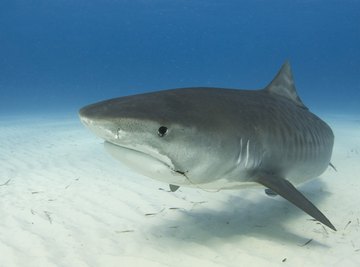

Sharks have a reputation for being bloodthirsty, all-powerful monsters lording over the ocean, but many of the hundreds of described species are actually quite small, retiring and inoffensive.
Almost all sharks face the prospect of predation at some point in their lives as they must deal with larger members of their own kind or even other shark species.
Shark Predators
Sharks are generally at the top of the food chain and great white sharks, for example, only have two known predators: orca whales and humans. In 1997, visitors to the Farallon Islands off the coast of California got a huge surprise and rare footage of an orca pod attacking and killing a great white.
Most impressively, the orca pod flipped the shark on its back, putting it into a catatonic state (tonic immobility), ate only the liver, and discarded the rest of the great white's body.
The other known shark predators are humans. Humans catch and kill over 100 million sharks every year. Shark fins are used in soups and considered a delicacy in Asia.
Hammerhead species have been listed as vulnerable (smooth hammerhead) or endangered (scalloped hammerhead) due to this practice. Although sharks cannot protect themselves from being fished, sharks do pursue a variety of strategies to stay out of harm’s way.
Size and Strength
Once they reach adult proportions, larger sharks deter most predators simply by being too big, strong and fierce to tangle with. Aside from orcas and, especially, bigger sharks, few marine creatures are capable of realistically tackling medium- to large-sized species such as most hammerheads (Sphyrnidae), requiem sharks (Carcharhinidae) and mackerel sharks (Lamnidae).
The huge filter-feeding sharks -- megamouths, basking sharks and whale sharks -- are not formidably toothy, but they’re so massive that only pods of orcas threaten them.
Threat Displays
Another shark defense is turning the powerful, tooth-filled jaws they use to subdue prey upon an attacker. The gray reef shark performs elaborate threat displays to ward off potential predators.
When it feels threatened, this bold, mid-sized member of the requiem shark family will hunch its back, raise its snout, droop its pectoral fins and swim with amplified movements. If the antagonist -- say, a scuba diver -- doesn't heed the warning, the shark may deliver a swift bite or two before taking flight.
Shark Defense: Weaponry
Aside from razor-sharp teeth and generally tough, abrasive hides, some sharks have specialized physical features that act as defensive armor. Certain species, such as the horn shark, have dorsal spines to discourage predation.
The small, bottom-dwelling swell shark displays one of the more distinctive anti-predator adaptations. Exposed to a threat, it will gulp in water -- or air, if it’s been removed from the sea -- to double its normal size. This transformation is particularly effective if the fish has retreated to a rocky nook, from which a predator would be hard-pressed to dislodge a fully swollen shark.
Camouflage and Cover
Another shark defense may include hiding from predators by camouflaging themselves against the seafloor or reefs. The flattened wobbegong of tropical waters is a standout example in terms of cryptic coloration, although its disguise is as much to support its ambush hunting as for lying low.
Mangrove swamps and seagrass beds function as important nurseries for many shark species, as hiding places are plentiful and large predators less common. In Bimini in the Bahamas, for example, young lemon sharks spend most of their first few years of life frequenting the tangled shelter of the island’s coastal mangroves.
Evasion
Lastly, shark defense could be taking active flight from potential predators. Some species are among the fastest fish in the ocean: The shortfin mako, likely the fleetest of all, can zip along at 50 kilometers per hour (31 miles per hour).
In 1998, researchers documented an attack on sevengill sharks -- a large, mainly deep-water species -- by four orcas off the Patagonian coast. Evidence suggested some of the sharks attempted to escape the whales by stranding themselves -- a rather extreme form of evasion.
References
- Biology of Sharks and Their Relatives; Jeffrey C. Carrier et al. (eds.)
- ReefQuest Centre for Shark Research: Requiem Threats: Agonistic Displays in the Grey Reef and Other Sharks
- Florida Museum of Natural History: Swell Shark
- Florida Museum of Natural History: Spotted Wobbegong
- Aquatic Mammals: Killer Whale (Orcinus orca) Predation on a Shortfin Mako Shark (Isurus oxyrinchus) in New Zealand
- ReefQuest Centre for Shark Research: Biology of the Shortfin Mako
About the Author
Ethan Shaw is an independent naturalist and freelance outdoors/nature writer based in Oregon. He holds a B.S. in Wildlife Ecology and a graduate certificate in G.I.S. from the University of Wisconsin-Madison. His primary interests from both a fieldwork and writing perspective include landscape ecology, geomorphology, the classification of ecosystems, biogeography, wildlife/habitat relationships, and historical ecology. He’s written for a variety of outlets, including Earth Touch News, RootsRated, Backpacker, Terrain.org, and Atlas Obscura, and is presently working on a field guide.
Photo Credits
Amanda Cotton/iStock/Getty Images