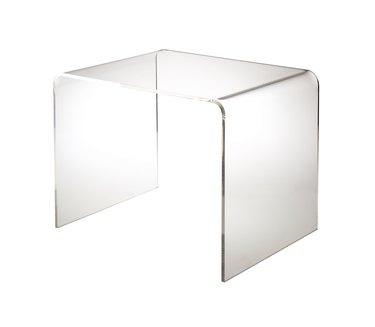
Lexan is the brand name for a type of clear polycarbonate sheeting that has a number of uses around the house, including aquarium, terrarium and safety-window construction. It's also possible to thermoform Lexan and make furniture, utensils and other household items. When you need to cut Lexan, you can essentially treat it as a sheet of plywood and cut it with any power saw you would use for that material. Make straight cuts with a circular saw or table saw, and curved ones with a band saw or jigsaw. You should use carbide-tipped blades with closely spaced teeth.
Step 1
Use a carbide-tipped blade with a tooth spacing of 1/2 inch or less when you cut Lexan with a circular saw. The teeth should have alternate 45-degree bevels to reduce chipping. The use of a circular saw is recommended only for sheets with a thickness of 3 mm or more.
Video of the Day
Step 2
Lay the sheet flat on a workbench with the off-cut overhanging the edge. Mark the cut line by scoring the plastic with a knife. Use a straightedge to guide the knife.
Step 3
Start the cut only after the saw is running at full speed. Proceed along the cut line at a moderate speed -- don't force the saw, or it may gouge large chunks from the plastic. Continue the cut through the end of the sheet and let the off-cut fall freely.
Step 4
Use a carbide-tipped blade with similar tooth spacing and rake angle as the circular saw when you cut on a table saw. Push the sheet through moderately quickly -- if you go too slowly, the blade can overheat the plastic and melt it.
Step 5
Cut curves with a band saw or jigsaw. When using either tool, equip it with a metal-cutting blade that has a tooth spacing of 2 to 4 mm.
Step 6
Clamp the sheet securely to the work table when cutting with a jigsaw, to minimize vibrations that can chip the plastic or throw the saw off its path. Operate the saw at low to medium speed.
Step 7
Support the Lexan sheet securely when you feed it through a band saw, clamping it to a piece of wood to stabilize it, if necessary. Move the blade guide down so it is as close to the sheet as possible to prevent blade from bending and wandering.
Video of the Day