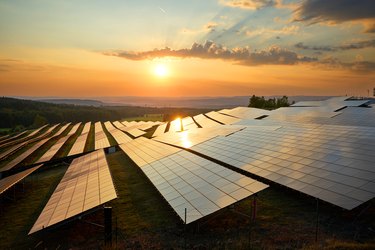
Dim lights dull the ambience you are hoping to achieve and battery chargers often fall short of building up your battery in good time. Pump up the brightness of your lights or rev up your battery charger with a solar panel you make yourself. Arm yourself with a bit of knowledge, a bevy of materials and a clear afternoon and you will have a working solar panel in your possession.
Project Points
Video of the Day
If you want to harness the sun and get relatively cheap energy, making a solar panel for small scale projects is an easy venture. When you build your own lights, charger or toy, they tend to be brighter and more efficient than those you can buy online and stick in the ground to soak up the sun.
Video of the Day
For a solar battery charger with more oomph, locate or purchase a unit that has a cigarette lighter connector. This allows for a larger solar panel to be directly connected to the charge controller. Find a solar panel with a higher power rating to get a faster recharge on your batteries. A 20-watt solar panel can reduce your recharging time to just a few hours for AAA, AA, C and D batteries. It may take longer for larger batteries such as those used for large flashlights or batteries, in which case a solar cell that has a trickle charger is ideal. A charge controller isn't needed for a 12-volt car battery or other larger battery because there is little concern of overcharging the massive device.
Cell phones and camera batteries have surprisingly high energy needs. Although the lithium-ion batteries appear small, they hold quite a lot of energy and can take longer to charge with a solar battery charger. You'll need a 20-watt solar panel to handle the task. A higher wattage panel is preferable to get the job done. Place the charge controller between the item and the solar panel so that it will easily disconnect when the battery is charged and not damage your phone or camera.
Using solar for small projects can ensure you have inexpensive power when you are away from the usual power sources or want to take it off-grid.
What and Where to Purchase
To complete your small solar panel project, you should educate yourself on the items that go into getting you the most energy for your time and money. A trickle charger gives a constant charge no matter the level of the battery's charge so use these with caution to avoid damaging your smaller batteries. A float charger has circuitry to stop the charge once the battery is full. Charge indicators have LEDs to tell you when the battery is charged. Solid solar cells produce more electricity than flexible solar foil but are less adaptable in tight situations if you are looking for a steady charge from solar energy. Foil works well for outdoor landscape lights and other more decorative projects. Kits can be bought online and cost approximately 10 to 30 percent less than buying a completed solar charger online.