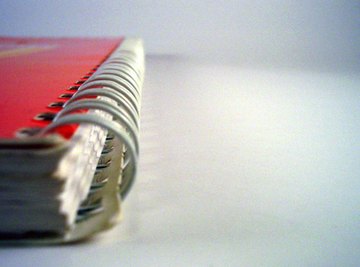

Record data properly by using a spiral-bound notebook, a pen and writing down all the details someone would need to replicate your project. All materials, data, experimental conditions and construction of apparatus and experiment must be recorded. Log dates, times, thoughts and observations of both the qualitative and quantitative variety. Write legibly but do not rewrite your logbook before your science fair competition. Include your logbook with your project display board, and keep your journal for the next school year in case you decide to continue your experiment.
- Single-subject, spiral-bound notebook with lined paper or bound marble composition notebook
- Black or blue pen
- Ruler
Record everything; no data is too insignificant. Do not use looseleaf paper or a binder. Use something that will hold the pages together instead. Mention things as you notice them rather than wait. List materials measurements in metric in addition to the American system. Remember your logbook is more than data; it's also a place for research notes and observations. Part of scientific practice is replication of experiments, so avoid logbook entries too general for other scientists to be able to use to repeat your experiment.
Avoid plagiarism. Take your own notes and always include a References Consulted list with your project. Make sure to include all measurements and warnings/cautionary statements with your materials notes. Do not fake data for any reason.
Purchase your logbook before you do anything with your experiment. Remember to always write in pen, as pencil will smudge. Leave the first page blank so you can create a table of contents later. Number each subsequent page in your logbook.
Start by logging your brainstorming sessions. Write the date at the top of the page and begin writing in complete sentences what ideas you have and what your hopes are for your experiment. End your first entry with how you made your decision and what your experiment will be.
Use your logbook to next identify your hypothesis and independent and dependent variables. Write in incomplete sentences for the rest of your logbook.
Record each day you do to research, and log both the book's title or website citation as well as a short explanation or summary of what you learned.
Consult your logbook often as you complete any science fair application forms, and make sure to include a copy of these forms with your logbook for later.
Get permission to start your experiment. Start purchasing your materials and designing your experiment. Record each decision, measurement and item in your logbook.
Explain any problems, modifications, additions or revisions to your experiment in your logbook immediately, as it can be very easy to forget details like this later.
Detail the entire experiment, noting day, times, room and project conditions and all data collected. Use the ruler to create tables, graphs and sketches. Describe anything you notice with your senses and anything which could be affecting your project adversely. Mention each and every tool and item used in each day of the experiment.
Mention when you take pictures of your experiment and each time you repeat a test. Note things you think should be changed in the future and any changes you make.
End your logbook at the conclusion of your experiment with analysis of your data, problems or limitations of this experiment and where you could continue in the future.
Avoid the temptation to rip out pages and recopy or even use correction fluids or tapes. Preserve the data and notes in a raw-draft form unless you want to explain to the science fair judges why you neglected to do so.
Make sure to have your logbook with you as you write any lab reports or prepare for visual or oral presentations. Never forget to include your logbook with your display come science fair day!
Things You'll Need
Tips
Warnings
References
About the Author
Alison Diefenderfer is a higher educational professional with experience in teaching and tutoring. She has been a freelance writer since 2007 and has been published in the science publication "AWIS Magazine." Diefenderfer has book reviews in both the "Journal of Latin and Caribbean Anthropology" and "Journal of International and Global Studies." She holds a Master of Science in interdisciplinary social science.
Photo Credits
notebook rings image by timur1970 from Fotolia.com