
How to Run a Good 500 Meter Dash

The 500-meter dash requires dedicated training as does any running event. This training involves running various lengths to prepare for the 500m. Stretching and being hydrated prior to the run are also necessary. Runners should focus on having a solid start. Working on lengthening and strengthening strides will help in the middle portion of the race. Lastly, the athletes must be able to go all out the last 100 meters and push strong through the finish line.
Have the right equipment. Make sure the shoes and clothing you train in are comfortable, useful and in good shape.
Train hard by doing various distances. For the 500m, working on 100-, 300- and 400-meter dashes will prove helpful so the runner can approach the 500-meter as basically a 400-meter run followed by an intense 100-meter dash to finish. Also, longer runs such as 800 meters will help the athlete in training for a successful 500-meter dash because the 500 will seem much more manageable after 800-meter training. Practicing starting strongly is another important training aspect.

George Doyle/Stockbyte/Getty Images
Drink plenty of water the day of the race and stretch and warm up thoroughly immediately before the race.
Get in a good starting stance. This element requires repetition in training to engage muscle memory. Be on your toes and think about pushing out, not up, when the starter gun fires.
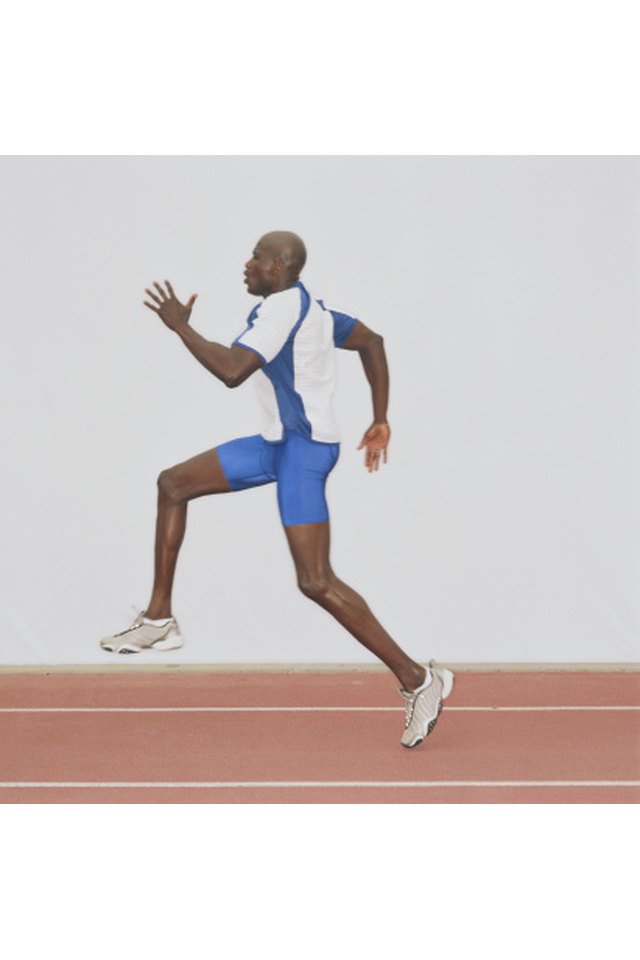
George Doyle/Stockbyte/Getty Images
Use big, powerful strides after the initial start. Get into a rhythm and don't think about the finish line yet. Focus on strong strides.
Explode when you reach the last straightaway which will mean about 100 meters of the race is left. Do not hold anything back at this point because it will be over quickly. Focus just beyond the finish line.

George Doyle/Stockbyte/Getty Images
Finish through the finish line, leaning in when crossing over. Do not slow up before crossing; run as hard as you can through that line.
Tips
Eating nutritious meals leading up to the race can improve your performance and give you the energy and stamina you need to run a great race.
Warnings
Stretching and hydrating are very important in avoiding injury.
Writer Bio
Shawndra Russell started freelancing professionally for several outlets in 2010, covering arts and entertainment, culture and society, health and fitness, sports and recreation, and travel. Russell earned her Bachelor of Arts in English from Ashland University and her Master of Arts in English from Marshall University.