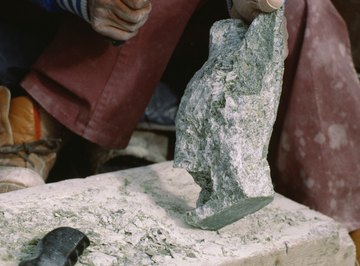
Stone carving has been around since before recorded time. While most artists now carve more for enjoyment and decoration than out of necessity, and although the techniques may have improved, much stays the same. Carving stone doesn't require heavy equipment, unless your sculpture is particularly large. Start small and work to something larger and more complex as you hone your sculpting skills.
- Stone
- Hammers
- Chisels
- Safety goggles
- Respirator (optional)
- Sandpaper
- Grinder
- Earplugs
- Shock-resistant gloves
- First aid kit
Hold the chisel at about a 45-degree angle. A higher angle only bruises the stone; a lower angle just skips over surface.
Select a design. Either discover a stone that suggests a design to you by the color or grain, or begin with a design idea, model it out of clay to work out the details and then find a stone that suits your idea.
Choose a stone. Many different types of stone or rock are available and suitable for carving.
Soapstone, which is also known as steatite, has a composition of talc, and feels somewhat slippery like soap. It is soft enough to be carved with a knife. The ease of carving, coupled with the stone's ability to hold fine detail and take a polish, make it an ideal choice for your first carving.
Alabaster is also a soft stone, but has a tendency to flake or split along cracks in the stone that are not always apparent. A high-polished finish can bring out its beautiful colors and patterns. You must wear a respirator when working with alabaster.
Limestone is easy to carve and takes small detail work well. It is also strong enough to support undercutting. Limestone has a very definite grain, and when carving, it breaks along the grain or "bed lines" easily. When carving across the grain, however, the stone is less reliable. Unlike many other rocks, limestone does not hold a polish. It's works well for outdoor sculpture.
Sandstone, like limestone, has a distinct grain that allows for easy flake removal. Carving sandstone is equivalent to using sandpaper on your tools, however, and it tends to dull them quickly. You must wear a respirator when working with sandstone due to the silica content.
Marble, although moderately hard to work, holds fine detail, comes in hundreds of colors and gleams under a high polish. These qualities have made it the top choice of sculptors for millennia. Use marble only for indoor sculptures, however, as outdoor elements deteriorate the surface and erode the stone in only a few years.
Granite is the hardest carving stone. Instead of carving with a hammer and chisel, you must use a carbide-tipped tools, diamond saws and grinders. Granite can have a very fine grain or a very course one. It comes in a number of colors, can be highly polished and lasts outdoors. Many gravestones are carved from granite. You must wear a respirator when working with granite due to the silica content.
Select your tools. Depending on the type of rock you are carving, you need some or all of the following tools: hammers (3 pound for removing large chunks, 2 pound for general carving, 1 pound for finer details); chisels (point for roughing out your carving, tooth for further refinement, flat and rondel for smoothing and to prepare the stone for finishing); pitching tool for removing large chunks of granite, tracing tool for more precision edges, rasps and rifflers smoothing; small grinder and sandpaper for shaping and polishing (course, medium and fine grit). For granite, you also need diamond saws, carbide-tipped pneumatic tools and an air compressor. To drill your stone, you need a pneumatic rock drill and carbide-tipped bits.
You also need a work bench, also called a banker, that is very sturdy to pound on the heavy rock without collapsing the table.
Keep appropriate safety gear on hand. Safety glasses, respirator, earplugs, shock-resistant gloves and a well-equipped first aid kit need to be within arm's reach for maximum safety.
Decide whether you want to create a relief sculpture where you carve an image that stands out from a flat surface, or a three-dimensional sculpture that you view from all sides.
Determine the direction of the stone's grain. Stone tends to split along the grain, or bed lines, easily. Design your carving so the stone's grain runs along the length of the sculpture. Remember that any small detail you carve may break off if the grain is running crosswise. Sketch out your design on the stone on the flat surface for a relief, or on all sides for a three-dimensional sculpture.
Rough out your carving with the pitching tool by hitting the top of the tool with a sharp blow of the hammer. Angle the tool toward the edge of the stone you want to remove. Use your chisels to cut parallel lines about an inch apart, being careful to avoid going too deeply into the stone. Crosshatch the ridges you made and then chisel along to pop off the cross-hatched ridges. Continue this process, removing the stone you don't want to remain in the final sculpture. Work the entire carving to the same stage all around to keep the sculpture at the same stage; this helps you visualize the finished sculpture. Once you have the rough form, use the tooth chisel to further refine it, the rondel to make concave cuts and the flat chisel to smooth the texture left behind by the tooth chisel.
Finish and polish your sculpture. For softer stones, the rasps and rifflers shape and smooth the contours of the final sculpture. Use silicon carbide wet and dry sandpaper for polishing. Start with the courser grits (40-80), work to the medium grit (150-320) and finish with the finest grits (400-1500). This brings out the amazing patterns and colors of the stone.
Things You'll Need
Tips
About the Author
This article was written by the CareerTrend team, copy edited and fact checked through a multi-point auditing system, in efforts to ensure our readers only receive the best information. To submit your questions or ideas, or to simply learn more about CareerTrend, contact us [here](http://careertrend.com/about-us).
Photo Credits
Photos.com/Photos.com/Getty Images