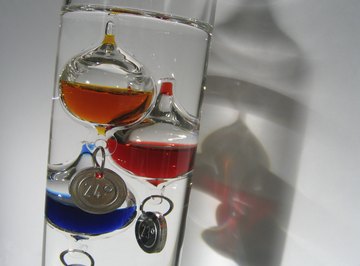

A Galileo thermometer operates on the principle of buoyancy, the phenomenon by which objects of greater density than their surroundings sink and less-dense ones float. The clear liquid inside the thermometer changes density as the temperature changes. The floating bulbs are tagged with calibrated counterweights indicating the temperature they represent. As the density in the clear liquid changes, its ability to support the differing weights of the bulbs and their tags also changes. By looking at which bulbs are sinking and which ones are floating, you can determine the temperature around the thermometer.
Identify the cluster of bulbs that have sunk to the bottom of the clear liquid. The temperature of the clear liquid has changed its density so it is no longer able to support the weight of these bulbs.
Identify the cluster of bulbs that have risen to the top of the clear liquid. The temperature of the clear liquid has changed its density so it forces the bulbs to float toward the top.
Identify the single bulb floating in the middle. It is neither sinking nor rising and is said to be neutrally buoyant. Read the tag on the neutrally buoyant bulb to get the temperature. If there is no bulb floating in the gap, use the lowest bulb from the floating cluster to get the temperature.
References
Photo Credits
Joseph Hoyle/iStock/Getty Images