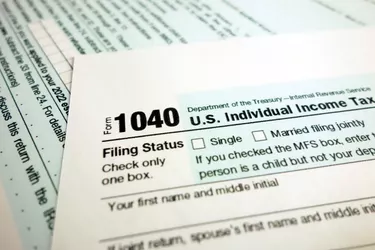
If you find yourself out of work because of an injury or illness, you may be able to claim short-term disability benefits. While these benefits can help you pay for everyday expenses as you recover, they are meant to replace your standard income, which means that they are usually taxed. When you fill out your 1040 tax return, you will need to understand how to enter short-term disability taxes.
What Is Short-term Disability Income?
Video of the Day
Short-term disability benefits are commonly paid to cover temporarily a certain percentage of your base salary in the event that you can't work. The reason for needing short-term disability benefits could be anything from a mental illness or physical illness to childbirth or an injury.
Video of the Day
If you're wondering if you qualify for short-term disability benefits, these benefits can work differently with each company. Some companies automatically provide short-term disability insurance immediately after hiring an employee.
There's also the possibility that your employer will not provide this insurance until you have worked for them for a specific period of time. When you qualify for short-term disability benefits, you can expect these benefits to cover anywhere from 40 percent to 80 percent of your base salary while you remain out of work.
Will I Receive a W-2 for Short-term Disability?
Because short-term disability income is automatically viewed as part of the salary you receive, your employer is required to list these benefits on a W-2 form, which will then be sent to you. Keep in mind that W-2 forms must be sent out by your employer by January 31.
While short-term disability tax forms may seem complicated, inputting the necessary information can be completed in five simple steps.
Is Disability Income Taxable?
If you're wondering if short-term disability benefits are taxable, the answer is that it depends on how the premiums for your short-term disability insurance were paid. If these premiums were paid in their entirety by your employer, you will be tasked with paying taxes on the benefits that you received while you were out of work.
In the event that you have paid all of these premiums, none of your benefits will be taxed. It's also possible that you paid just for a portion of the insurance premiums with your employer paying the rest. In this situation, the portion of the premiums that was paid by your employer will be taxed and must be reported on your 1040 form.
Input Short-term Disability to 1040 Form
While short-term disability tax forms may seem complicated, inputting the necessary information can be completed in five simple steps:
The first thing you should do is find the amount of short-term disability income that's listed on your W-2 form. This income is combined with any other wages and tips that you've earned for the year in Box 1. All of the wages shown in Box 1 are taxable. On the other hand, your nontaxable disability wages will be displayed in Box 13 on the W-4, and you don't need to include these wages on your 1040 form. If you don't see any wages listed in Box 1, this means that your short-term disability income isn't taxable for the year.
The second step in this process involves filling out Form 1040. The initial three sections of this form center around personal information, dependents and filing status. This information should be provided as usual.
The third step is to fill out line 1 of your Form 1040 will include your income from your employer including the short-term disability income subject to taxes.
The fourth step is to complete the rest of your Form 1040 to claim any other income, deductions, credits and tax payments.
The fifth and final step involves signing the completed 1040.
It's not always easy to understand how short-term disability income is taxed. Once you do, however, placing this information on Form 1040 is easy as long as you know where your income should be input.