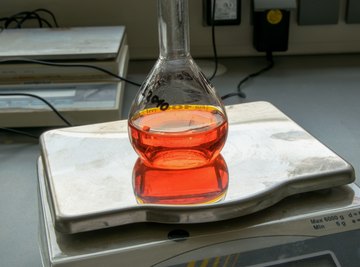

The density of a solid, liquid or gas is its mass per unit volume. To find the density (∂), you weigh the object to find its mass (M), you calculate the volume it occupies (V), then divide the mass by the volume: ∂ = M/V. Once you know density, you calculate specific gravity (SG) by dividing the density of the object by the density of water (∂w). In equation form: SG = ∂/∂w. Because this number is dimensionless, it's valid for whatever system of units you choose. If you need density in pounds per gallon, just multiply specific gravity by the density of water in those units.
TL;DR (Too Long; Didn't Read)
The density of water at 4 degrees Celsius is 8.345 lbs/U.S. gal. Multiply the specific gravity of any solid or liquid by this number to get the density in pounds per U.S. gallon.
What Is Specific Gravity?
Specific gravity is a quantity that applies to solids, liquids and gases. When calculating the specific gravity of a gas, you take the density of the gas at standard temperature and pressure and compare it to air under the same conditions. For solids and liquids, the standard of comparison is water at 4 degrees Celsius, because water has its maximum density at this temperature. According to this definition, water at any other temperature has a specific gravity of less than one. When you dissolve a solute in water, the change in specific gravity can help determine the solute concentration, as long as you know the chemical formula of the solute.
Calculating Density in Pounds per Gallon
Since specific gravity is a ratio of the density of a solid or liquid to the density of water, all you have to do to find the density, given the specific gravity, is to multiply the specific gravity by the density of water. If you're looking for density in pounds per gallon, you need to know the density of water at 4 degrees Celsius. It is 62.424 lbs/cu ft. Since there are 7.48 U.S. gallons in a cubic foot, this is equivalent to 8.345 pounds/U.S. gallon. This is all you need to convert from specific gravity to pounds per U.S. gallon.
For example, the specific gravity of aluminum is 2.72, so its density is (2.72) • (8.345 lbs/U.S. gal) = 22.7 lbs/U.S. gal. In other words, if you have a U.S. gallon of aluminum, it will weigh 22.7 pounds.
U.S. and Imperial Gallons
The U.S. liquid gallon is smaller than the U.S. dry gallon, and both are smaller than the Imperial gallon. One U.S. liquid gallon is equivalent to 0.86 U.S. dry gallons and 0.83 Imperial gallons. In other words, one U.S. dry gallon = 1.16 U.S. liquid gallons, and one Imperial gallon = 1.2 U.S. liquid gallons.
If you need a density in U.S. dry gallons or Imperial gallons, multiply the density of water (8.345 lbs/U.S. gal) by either 1.16 or 1.2 respectively.
References
About the Author
Chris Deziel holds a Bachelor's degree in physics and a Master's degree in Humanities, He has taught science, math and English at the university level, both in his native Canada and in Japan. He began writing online in 2010, offering information in scientific, cultural and practical topics. His writing covers science, math and home improvement and design, as well as religion and the oriental healing arts.