How to Wire a Bridge Rectifier

A bridge rectifier converts alternating current (AC) to direct current (DC). All electronic devices that plug directly into a wall receptacle use bridge rectifiers to convert AC voltage to DC voltage.
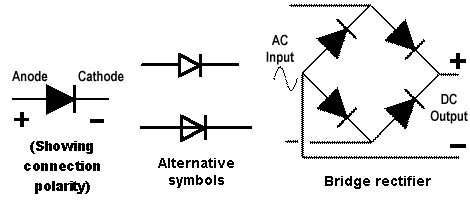
Wiring a bridge rectifier is not a difficult project, but you should print out the circuit diagram and diode symbols from the Resource links, and familiarize yourself with these symbols and the bridge rectifier diagram before you begin work.
Things You Will Need
- 35-watt soldering iron or a soldering station
- Soldering sponge
- Rosin-core solder
- 4 silicon power diodes
-
Plug the soldering iron into the wall outlet, or turn the soldering station's power switch to the "On" position. Allow enough time for the soldering iron to get hot. Meanwhile, wet the soldering sponge with tap water.
-
Clean the hot soldering iron tip by wiping it on the wet soldering sponge. Be sure to wipe the tip free of all dirt and oxidation before proceeding.
-
Apply a fresh coating of rosin-core solder to the freshly cleaned soldering iron tip. This is known as "tinning" the soldering iron tip.
-
A properly cleaned and tinned tip has a bright silvery color. If the tip remains a dull gray, repeat the cleaning and tinning process. A properly tinned soldering tip is necessary to make reliable soldered connections.
-
Lay out the four diodes as positioned in the diagram that you printed out (see Resources). As you see in the drawing, the line running around one end of the diode's body indicates the diode's cathode or negative lead; the opposite lead is the diode's anode or positive lead (as respectively indicated by the - and + signs).
-
The direction of current flow through a diode is from cathode to anode (i.e., opposite to the direction in which the arrow points). Diodes are electronic check valves that permit current to flow in one direction only.
-
Apply the hot soldering iron tip to the underside of each connection. Wait a couple of seconds and then touch the rosin-core solder to the top of each connection. The heat will draw the solder around and between the diode leads.
-
Do not keep the soldering iron tip in contact with these wires longer than necessary, because too much heat can damage the diodes. An effective solder joint, like a properly tinned soldering iron tip, will have a bright silvery color. A dull gray color indicates an ineffective joint known as a "cold solder joint." If this happens, unsolder the connection, and solder it again.
-
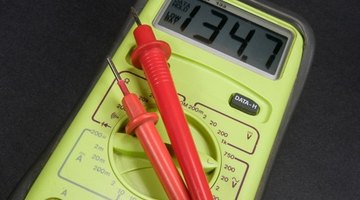
Check your wiring. Set the function switch on your digital multimeter to the "Diode Test" position. Place the red test probe on the side of the bridge circuit where the diode's anodes are joined together (i.e., the line with the negative signs on the diagram). Place the black test probe on the side where the two cathodes are joined (the line with the plus sign in the diagram). The meter should indicate 3.0 to 4.0 on the liquid crystal display (LCD).
-
Reverse the probes and retest. The meter should now indicate an infinite resistance. These readings indicate that you have wired the diodes correctly.
The Drip Cap
- A bridge rectifier converts alternating current (AC) to direct current (DC).
- All electronic devices that plug directly into a wall receptacle use bridge rectifiers to convert AC voltage to DC voltage.
- Wiring a bridge rectifier is not a difficult project, but you should print out the circuit diagram and diode symbols from the Resource links, and familiarize yourself with these symbols and the bridge rectifier diagram before you begin work.
- Meanwhile, wet the soldering sponge with tap water.
- If the tip remains a dull gray, repeat the cleaning and tinning process.
- Place the red test probe on the side of the bridge circuit where the diode's anodes are joined together (i.e., the line with the negative signs on the diagram).
- The meter should now indicate an infinite resistance.
References
Resources
Writer Bio
Based in Colorado Springs, Colo., Jerry Walch has been writing articles for the DIY market since 1974. His work has appeared in “Family Handyman” magazine, “Popular Science,” "Popular Mechanics," “Handy” and other publications. Walch spent 40 years working in the electrical trades and holds an Associate of Applied Science in applied electrical engineering technology from Alvin Junior College.
Photo Credits
- The Readout image by Cinneman from Fotolia.com
- The Readout image by Cinneman from Fotolia.com
More Articles