Whether you own a dog breed of German heritage or you simply like the sound of German commands, training your dog to understand Deutsche can be a mutually enriching experience. Your first step entails choosing which commands you wish to teach; your second step is learning to pronounce them correctly so that you can speak the words confidently without confusing your dog. After that, it's your dog's turn to learn that from now on "sitz" means sit in German.
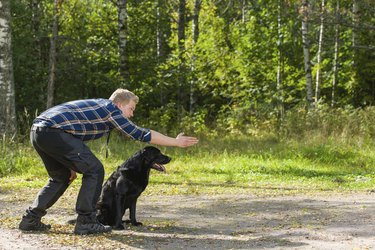
Video of the Day
Clarity above all
A major benefit of training commands in German is that they're easily distinguishable from English. For instance, dogs often hear the words "stop," "come," or "sit" in our everyday conversations out of training contexts, which can be confusing. German commands are clear, distinct, and most likely are commands nobody else will replicate to confuse your dog. That's one reason some law enforcement officers like to stick to their imported dog's native language, whether it's German, Hungarian, Czech, or Dutch.
Video of the Day
Start dog training early
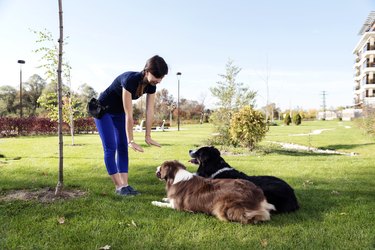
The best way to train German commands is to start with a puppy. A puppy is a clean slate and can be easily introduced to commands in any language. Simply introduce the German commands as you would with English commands, teaching "sitz" instead of sit. With older dogs who have been trained with English commands, things can get a bit tricky. You'll need to allow time to acknowledge the new commands and associate the desired behaviors of the old commands with the new ones.
Lesson 1: Basic commands
Your dog's basic commands are standard commands taught in obedience classes including sit, down, stay, come, and heel. "Sitz" is the German command for sit and it's pronounced just as you read it. "Platz" in German (pronounced "plats") means down. "Bleib" (pronounced "bly'b") means to stay in German. "Hier" (pronounced "hee-er") as the word implies, means come here, and "fuss" (pronounced "fooss") means heel.
Lesson 2: Advanced commands
These aren't your ordinary commands, but they're helpful if you're planning to do advanced training. For instance, if you're doing agility, you may be interested in training "hopp" (pronounced hup), which means jump, and if you're doing search and rescue, you may be interested in training "gib-laut" (pronounced gib-laout) to train your dog to bark to alert you of his findings.
Lesson 3: Training in German
Once, you have chosen which commands you want to teach and can pronounce them, it's time to train your dog. Focus on one command at a time. Start by saying the new German command. If you want your dog to learn both, you can follow it with the known English command. For instance, say "platz" followed by "down" and then praise and reward your dog for complying. Repeat multiple times in different environments. When your dog gets it, give plenty of praise.
Lesson 4: Testing the waters
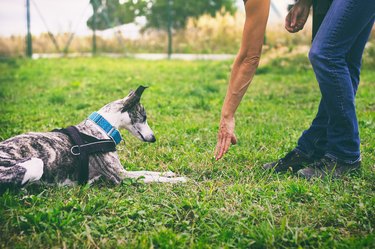
If your dog already knows English commands, use both the German and English until he makes the association. When you think your dog is ready, you'll want remove the old command so you can rely exclusively on the German one. A good time to do this is when your dog responds to the German command even before he hears the English command.
Next, test the waters by saying the German command alone to see if your dog complies. If he does, praise lavishly and reward your dog. If your dog has trouble, try practicing more using both commands.
Remember that dogs don't learn language the way that we do and therefore aren't limited in the number of commands they can learn in different languages. It is up to you to be patient and consistent to teach the meaning and expected behavior associated with new words, regardless of the language. They don't know whether you're speaking English, German, or Italian. The main thing they respond to is the sound of the word and the consistency in which it's used.