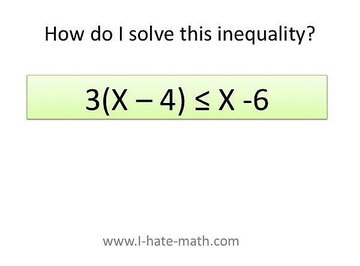

Inequalities are similar to equations, you have to solve for a variable (X, Y, Z , A, B, etc...), the main difference is that with an equation you are solving for only one value (X=3, Z=4, A=-9, etc) with an inequality you are solving for a range of numbers, that means that you variable can be a number greater than, less than, greater or equal than to, less or equal than to...
For Example: If X > 3 (X is greater than 3) , X can be any value from 3.1, 3.2, 5, 7, 900, 1000 and so on.
If you want to see this article as a video, please visit us at WWW.I-HATE-MATH.COM
- PEN
- PAPER
Check our other articles about how to solve equations if you are having trouble solving for "X" Understand the inequality symbols If you divide by a negative number both sides, your inequality symbol will flip to the opposite side. For Example: -3X>6, -3X/-3 > 6/ -3, then X<-2, if you have doubts, just plug your answer and make sure makes sense, in our example X has to be less than -2 , so -3(-3) > 6, 9> 6, if you do not flip the inequality then your answer would be wrong.
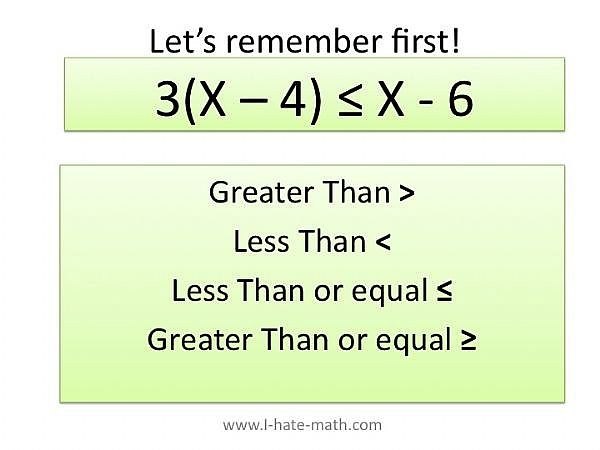
Let's remember the symbols for inequalities
Greater than >
Less than < Greater than or equal to ≥ Less than or equal to ≤

We have the inequality 3(X-4) ≤ X - 6. Let's solve for "X" , that means to leave "X" alone. We can solve this like a regular equation.
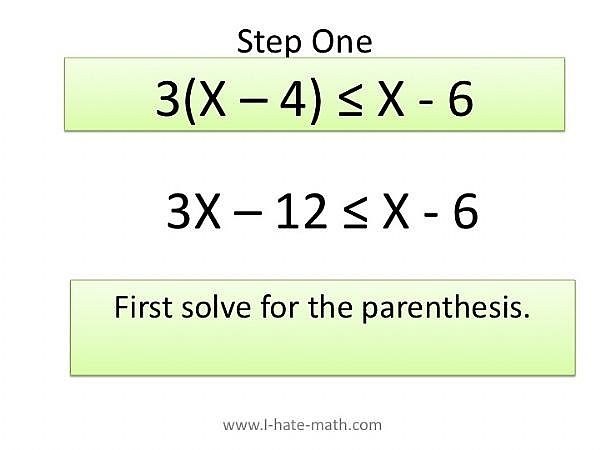
First we need to remember PEMDAS (Please Excuse My Dear Aunt Sally). We have to solve for the parenthesis. Let's multiply 3 times X, and 3 times -4

Once we do the parenthesis, 3x - 12 ≤ X -6, let's move the "X" from the right to the left side, we do this by adding "X" to both sides.
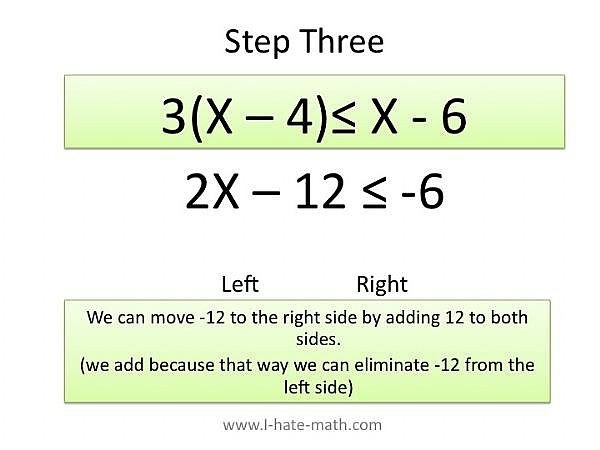
Our inequality looks like this 2X - 12 ≤ X -6. Now we have to move -12 from the left to the right side, let's add 12 to both sides.

Our main goal is to leave "X" alone, 2 is multiplying X, let's eliminate him from the left side by dividing both sides by 2
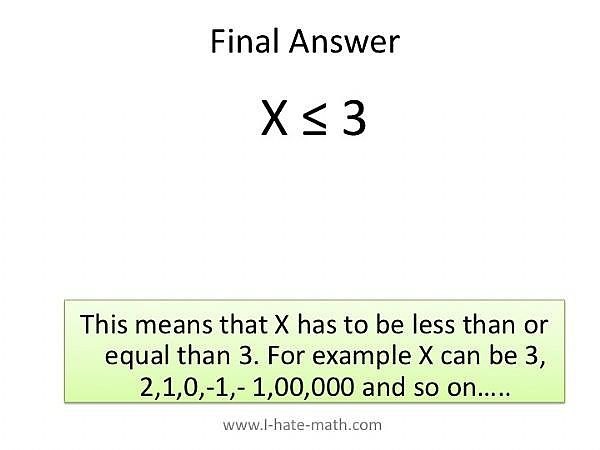
Our result is X ≤ 3, that means that the value of X has to be a number less than or equal to the number 3. For example 3, 2, 1, 0 -1, -2, -3 and so on. We can also write our answer like this (-∞, 3], we use always parenthesis for the infinitive symbol , and we use a bracket because our inequality is less than or equal to. If our equation was 3(X-4) < X -6, then our answer would be ( -∞, 3) with a parenthesis, this means that X can not be 3, it has to be less than 3, for example 2.99, 2.50, 0, -1, -2, -3 . Conclusion. If you have an inequality with the equal symbol (≤≥) , you have to use the bracket [], if you have the inequality without the equal symbol (<>), then you have to use parenthesis ()
Things You'll Need
Tips
Tips
- Check our other articles about how to solve equations if you are having trouble solving for "X"
- Understand the inequality symbols
- If you divide by a negative number both sides, your inequality symbol will flip to the opposite side. For Example: -3X>6, -3X/-3 > 6/ -3, then X<-2, if you have doubts, just plug your answer and make sure makes sense, in our example X has to be less than -2 , so -3(-3) > 6, 9> 6, if you do not flip the inequality then your answer would be wrong.
About the Author
This article was written by the CareerTrend team, copy edited and fact checked through a multi-point auditing system, in efforts to ensure our readers only receive the best information. To submit your questions or ideas, or to simply learn more about CareerTrend, contact us [here](http://careertrend.com/about-us).
Photo Credits
www.I-hate-math.com, Vanessa Graulich, I Hate Math Group, Inc