Things You'll Need
Bridal fabric (matching the original dress fabric and color)
Seam ripper
Sewing machine
Scissors
Fast turn
Pattern paper
Pencil
Thread
Ribbon/cord
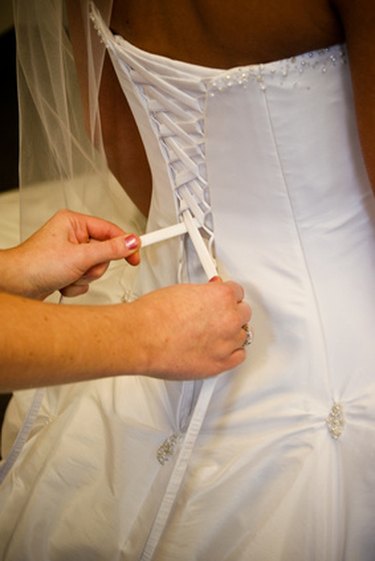
Adding a corset back helps you fit into your wedding dress perfectly and saves you valuable money. Perhaps you've decided to wear your mother's dress or buy one off the rack, which you deem perfect for your wedding. The dress fits you well for the most part, but it just wouldn't zip all the way up the back. Creating a corset back, therefore, is a good, inexpensive solution. A corset back also complements most wedding dress styles and body types.
Making the Loops
Step 1
Remove the zipper at the back of the wedding dress with a seam ripper, being careful not to damage the dress. Once the zipper is removed, trim the excess zipper tape with scissors, leaving just enough for attaching the loops later.
Video of the Day
Step 2
Make spaghetti straps. Cut a strip of fabric that matches the original dress fabric (bridal satin, silk, duchess satin, etc.), 1 inch wide and at least 12 inches long. Sew the ends together vertically, at about 1/4-inch from the edge. Trim the excess seam and turn it inside-out, using a fast turn. You now have a very narrow spaghetti strap.
Step 3
Cut the spaghetti strap into about 1 1/4-inch long segments to serve as loops.
Step 4
Repeat steps 2 and 3, making as many loops as necessary for the entire length of the gap at the back of the dress. Remember to make an equal number of loops for both sides of the opening.
Step 5
Trace a ready-made corset's loops on paper to make a pattern for sewing together your loops. On the pattern paper, sew in the loops one at a time in a straight line down the middle, making the segments that meet criss-cross with each other. Peel the sewn loops away from the pattern paper.
Step 6
Pin the loops to the underside of the dress opening, from top to bottom. Sew them close to the edge of the cloth, leaving tiny loop openings that are just enough for the ribbon/cord to fit through snugly later on. Remove the pins. Do the same on the other side of the gap, making sure there are an equal number of loops on either side and that they are at the same level with each other.
Modesty Panel
Step 1
Fold the fabric (the same one where you got the loops fabric from) and cut into a V-shape, slightly wider and longer than the dress gap. The fold line should be on top and narrow to the bottom.
Step 2
Sew together one side of the modesty panel and turn it inside-out. Sew the unstitched side to the left side of the dress opening, leaving the other side hanging loose.
Step 3
Sew the original dress lining on top of the loop and modesty panel, making a neat edge.
Ribbon/Cord
Step 1
Take a 1/2 to 1-inch wide ribbon (organza and satin are good choices) or cord and cut it to a length of about 3 yards. This will give you enough flexibility in tying and adjusting the ribbon/cord later on.
Step 2
Insert the ribbon/cord into the loops, from top to bottom of the dress opening, criss-crossing them at the center. Make the lacing loose enough at this point to allow you to put on the dress.
Step 3
Once you've put on the dress, adjust the lacing of the corset back, so the ribbon/cord ends are of equal length and the dress fits you perfectly. Tie a knot at the bottom to secure it in place and create a simple bow for a beautiful finish.
Video of the Day