

How to Restain Kitchen Cabinets

There are different approaches to restaining your kitchen cabinets, depending on your desired results. If you want to stain your cabinets darker than they already are, you can apply a gel stain over the existing finish after some light sanding.
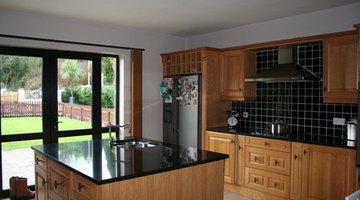
Things You Will Need
- Screwdriver
- Degreaser
- Plastic sheeting
- Electric hand sander
- Foam sanding block
- Sandpaper
- Vacuum with hose attachment
- Paintbrush
- Gel stain or other stain
- Clear wood finish
If you want to lighten your cabinets or stay close to the shade you have now, you have to remove the old stain completely.
-
Unscrew all the hardware on the cabinet doors and set them aside. Protect your work surface with a plastic sheet and place your cabinet doors on it. Place another plastic sheet under the cabinets.
-
Wash the doors and finished portions of the cabinet bodies with a degreaser, such as trisodium phosphate (TSP). Allow the wood to dry completely.
-
Sand the doors and frames. If you're darkening your cabinets with gel stain, sand the door and cabinet frames by hand, just enough to rough up the surface. Otherwise, use the electric hand sander on the surfaces until all the old finish is removed.
-
Remove the dust created by sanding with a vacuum with a hose attachment. Use a clean, dry paintbrush to brush away any remaining dust.
-
Apply a thin coat of stain to the cabinet doors and frames with a paintbrush, using long, even strokes. Work in the direction of the wood grain. Allow the stain to dry for 24 hours.
-
Apply a second coat of stain if your cabinets are not dark enough. Skip this step if you are satisfied with the results after one coat of stain.
-
Apply two coats of clear wood finish, such as polyurethane or varnish. Allow the cabinets to dry for 24 hours.
Tip
Wear a dust mask when sanding.
Check out this related video from Homesteady on Youtube.
References
- "Black and Decker: The Complete Guide to Kitchens"; Editors of Creative Publishing; 2004
- House Painting Info: Restain Cabinets for a New Look
Tips
- Wear a dust mask when sanding.
Writer Bio
Jen Anderson has been writing professionally since 2008. Her work has appeared in the "New York Times," "Time Out Chicago" and "The Villager." She has a Master of Fine Arts in creative writing from Brooklyn College.
Photo Credits
- the kitchen. image by guiney from Fotolia.com
- the kitchen. image by guiney from Fotolia.com
More Articles

