
Seven Rules of Exponents

Seven Rules of Exponents thumbnail
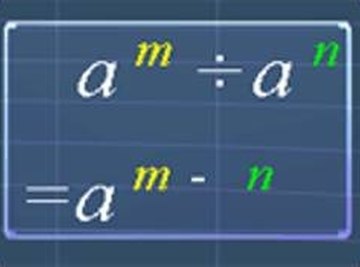
Quotient of Powers Property

The seven rules of exponents are vital in learning how to solve math problems dealing with exponents. The rules are straightforward and can be remembered through practice. Some of the more common rules deal with adding, subtracting, multiplying and dividing exponents. It is important to remember that these rules are for real numbers.

Instructions

    • 1

      Practice and understand the Zero Exponent Property. This property states that any number raised to the power of zero equals 1. For example, 2^0 = 1.

    • 2

      Learn the Negative Exponent Property. This property states that any negative exponent can be converted to a positive by flipping the fraction. However, the integer must not be zero. For example, 2^-3 would be written and solved as 1/2^-3 = 1/8.

    • 3

      Understand the Product of Powers Property. This property states that when multiplying the same integer with different exponents, you can add the exponents together. The integer must not be zero. For example, 2^5 x 2^3 = 2^(5+3) = 2^8 = 256.

    • 4

      Learn the Quotient of Powers Property. This rule states that when dividing the same integer with different exponents, you subtract the exponents. The integer must not be zero. For example, 2^5 / 2^3 = 2^(5-3) = 2^2 = 4.

    • 5

      Understand the Power of a Product Property. This property states that when two or more different integers with the same exponent are being multiplied, the exponent is only used once. For example, 2^3 x 4^3 = (2 x 4) ^3 = 8^3 = 512.

    • 6

      Learn the Quotient of a Product Property. This property states that division between two different integers with the same exponent is solved by dividing the integers, then applying the exponent. For example, 4^3 / 2^3 = (4/2) ^3 = 2^3 = 8.

    • 7

      Learn the Power to a Power rule. This rule states that when a power is raised to another power, you multiply the exponents. For example, (2^3)^2 = 2^(3 x 2) = 2^6 = 64.

Tips & Warnings

  • Remember that any number with an exponent of 1 is equal to the number. For instance, 2^1 = 1.

  • Be careful not to mix up Product of Powers and Power of a Product properties. One means to add the exponents, while the other only uses the exponent once.

Related Searches:

Resources

  • Photo Credit Mathexpression.com

Comments

You May Also Like

  • How to Use the Laws of Exponents

    Although exponents may appear complex when simply looking at them on a page, using them to solve a mathematical formula is as...

  • 10 Laws of Exponents

    10 Laws of Exponents. One of the trickiest concepts in algebra involves the manipulation of exponents, or powers. Many times, problems will...

  • What Are the Eight Rules of Exponents?

    While there are more than eight mathematical rules involving exponents, the Eight Rules of Exponents are a core set of principles which,...

  • How to Add and Subtract Exponents

    Adding and subtracting exponents is as simple as adding and subtracting any other number, once you get the exponents in a certain...

  • What Is the Product Rule for Exponents?

    When working with algebraic expressions that have exponents, there are a number of rules about exponents that can help simplify the expression....

  • Quotient Rule for Exponents

    The quotient rule is one of several useful rules for exponents, whether you're doing basic multiplication or algebra. The quotient rule allows...

  • Exponents Rules

    Exponents are used to simplify expressions by showing how many times a number is multiplied by itself. For example, x * x...

  • The Rules of Dividing Exponents

    The Rules of Dividing Exponents. In algebra, exponents are the expressions used to show you how many times you must multiply the...

  • Exponent Rules in Math

    Exponents are a useful tool in math, allowing you to calculate long strings of multiplication quickly. An exponent simply means that the...

  • Rules on Positive Integer Exponents

    Rules on Positive Integer Exponents. A positive integer is any whole number equal to or greater than one. For example, 11 would...

  • Rules of How to Combine Exponents

    Exponents are used to shorten expressions by simplifying like terms that are multiplied. For example, the expression z * z * z...

  • Rules for Multiplying Exponents

    Rules for Multiplying Exponents. Many algebra problems use exponents when multiplying the same values together. Using exponents make it easier to write...

  • Rules When Using Variables As Exponents

    Rules When Using Variables As Exponents. Exponents are a standard feature of the mathematical landscape. When written, exponents are small numbers or...

  • Exponent Rules for Addition

    Working with exponents is not as difficult as it seems, especially if you know the function of an exponent. Learning the function...

  • Laws of Exponents for Multiplication & Division

    The exponent of a number tells you how many times to multiply the number. The rules of exponents follow the logic of...

  • The Rules of Adding Exponents

    The Rules of Adding Exponents. When you square a number, cube a number or take a number to a power, you are...

  • The Rules for Rational Exponents

    The Rules for Rational Exponents. An exponent is a form of mathematical notation that tells you how many times to multiply a...

  • The Origin of Exponents

    Exponents indicate that a number should be multiplied by itself repeatedly and are used to shorten and clarify mathematical notation. As a...

Related Ads

Featured