
What does fact checked mean?
At SportsRec, we strive to deliver objective content that is accurate and up-to-date. Our team periodically reviews articles in order to ensure content quality. The sources cited below consist of evidence from peer-reviewed journals, prominent medical organizations, academic associations, and government data.
- American College of Sports Medicine: Delayed Onset Muscle Soreness (DOMS)
- American College of Sports Medicine: Delayed Onset Muscle Soreness (DOMS)
- Current Review of Musculoskeletal Medicine; Gastrocnemius vs. Soleus Strain: How To Differentiate and Deal With Calf Muscle Injuries
- Current Review of Musculoskeletal Medicine; Gastrocnemius vs. Soleus Strain: How To Differentiate and Deal With Calf Muscle Injuries
- American College of Sports Medicine: Overtraining with Resistance Exercise
- American College of Sports Medicine: Overtraining with Resistance Exercise
- American Council on Exercise: Seated Calf Stretch
The information contained on this site is for informational purposes only, and should not be used as a substitute for the advice of a professional health care provider. Please check with the appropriate physician regarding health questions and concerns. Although we strive to deliver accurate and up-to-date information, no guarantee to that effect is made.
Calf Pain After Using an Elliptical Machine
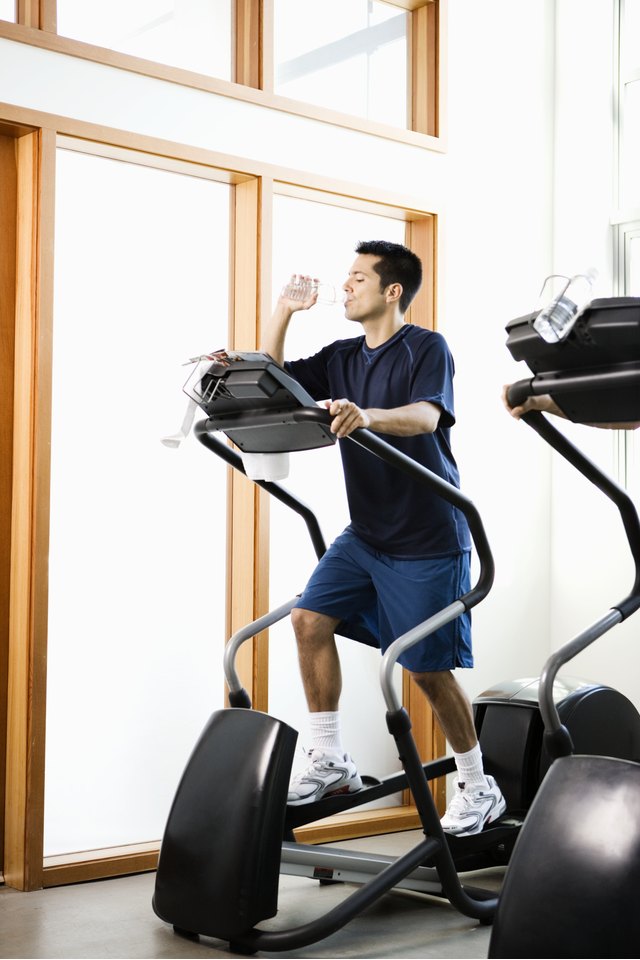
Elliptical trainers offer the cardiovascular workout of running without the knee-jarring impact. While available with elaborate add-ons, a slimmer, budget conscious model may fit nicely in your home -- bringing the convenience of the gym to your living room. As with any exercise machine, there is a chance the elliptical could cause certain individuals pain. That includes discomfort involving your gastrocnemius, soleus and plantaris muscles -- or the calf.
Delayed Onset Muscle Soreness
Delayed onset muscle soreness, or DOMS, will cause soreness in your calves half a day to one day after your elliptical exercise and can intensify anytime within the next 24 to 72 hours. Pain from DOMS comes from your body repairing microscopic muscle tears. The sorer you are, the harder you worked the damaged muscle. While DOMS is generally not cause for concern, you may want to stay off the elliptical for a couple of days. Go for a light walk, if your calves will tolerate it, and then ease back into your elliptical workout.
Pacing Workouts
You really can get too much of a good thing, as the American College of Sports Medicine confirms. Pushing yourself by increasing the elliptical's resistance before you're ready or not giving yourself a proper rest between workouts causes overtraining, which increases the risk of injury. Overtraining, according to the ACMS, also reduces your performance, lengthens recovery time and can even affect your immune system. Avoid overtraining by slowly increasing your resistance as your ability level increases and adding time gradually in increments of about five minutes each week.
Strains
Peddling your elliptical backwards works your calves more than peddling forward, but done with too much resistance it can strain the gastrocnemius, soleus and plantaris muscles. The movement on the elliptical can strain all three; however, because the elliptical simulates running, a calf strain is more likely to affect the soleus muscle. Look for a stiff calf that gradually becomes more painful and tighter within a few days. This condition should be treated by a physician.
Reducing and Preventing Calf Pain
While muscle discomfort is common when starting on the elliptical, stretching before and after your workout can lessen calf pain. Begin with active stair calf stretches. Center the balls of your feet on the edge of a step. Then, tighten your glutes as you drop your heels off the step until you feel a stretch in your calves. Return to the starting position. Repeat the stretch until your calves feel loose. Follow your elliptical session with seated calf stretches of four on each leg. Sit on the floor with your legs out. Place an exercise band around the sole of your left foot and grab both ends. Straighten both legs and pull on the bands. Feel your calf stretch as your toes curl toward you. Hold the stretch for 30 seconds and then release. Do at least four on each leg.
References
- American College of Sports Medicine: Delayed Onset Muscle Soreness (DOMS)
- Current Review of Musculoskeletal Medicine; Gastrocnemius vs. Soleus Strain: How To Differentiate and Deal With Calf Muscle Injuries
- American College of Sports Medicine: Overtraining with Resistance Exercise
- The Outdoor Athlete; Courtenay Schurman and Doug Schurman
- American Council on Exercise: Seated Calf Stretch
- Hohmann E, Reaburn P, Tetsworth K, Imhoff A. Plantar Pressures During Long Distance Running: An Investigation of 10 Marathon Runners. J Sports Sci Med. 2016;15(2):254–262.
- Damiano DL, Norman T, Stanley CJ, Park HS. Comparison of elliptical training, stationary cycling, treadmill walking and overground walking. Gait Posture. 2011;34(2):260–264. doi:10.1016/j.gaitpost.2011.05.010
Writer Bio
Having studied at two top Midwestern universities, Catherine Field holds degrees in professional writing and patient safety. Writing since 2000, Field has worked with regional newspapers while publishing fiction online. She conducts medical communication research at a Midwestern medical institution and is slated to write a book based on her research findings.