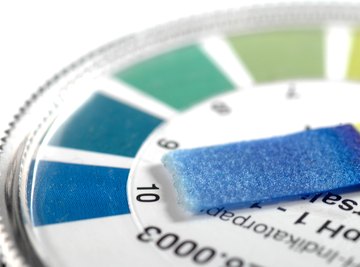

When you want to determine the acidity or alkalinity of a liquid or water-soluble gas, the easiest way is to perform a litmus test. The test requires litmus papers, which are narrow strips of paper treated with chemical solutions that are sensitive to pH changes. The pH number expresses the acidity or alkalinity of a solution on a logarithmic scale from zero to 14. On the scale, 7 is neutral. Values lower than 7 are more acid with 0 being the most acid, and values higher than 7 are more alkaline with 14 being the most alkaline. The term "basic" is often used interchangeably with "alkaline." A pH value of 14 is the most basic.
Using Litmus Papers in Water
Pour an aqueous sample (or dissolve a sample in water) into a glass or beaker. The litmus test does not work if the sample is not aqueous. Nearly everything is acid or alkaline except pure water, which is neutral, so it has a pH value of 7 on the scale.
Hold one end of a piece of red litmus paper, dip it into the sample and then remove it. There is no need to leave it in the sample for any length of time because any color change is immediate. Repeat this step with a piece of blue litmus paper. Again, there is no need to leave the paper in the sample for any length of time.
Analyze how each paper reacts to the sample. If the liquid is alkaline, the red paper turns blue, and the blue paper does not change. If it is acidic, the red paper does not change, and the blue paper turns red. If it is neutral, neither the red paper nor the blue paper change.
Using Litmus Papers With Gas
- Red litmus paper
- Blue litmus paper
- Glass or beaker
- Fume hood
- Appropriate safety gear, such as gloves and lab coat
Minors should be supervised at all times when handling chemicals.
Wet a red piece of litmus paper and a blue piece of litmus paper with water. Use the correct safety precautions for the gas you are testing.
Under a fume hood, open the container of gas and allow some of it to come in contact with both pieces of paper. Place the papers in contact with the gas. Litmus papers react to gasses the same way they react to liquids, except gas reacts more evenly across the entire surface of the paper.
Analyze how each paper reacts to the sample. If the gas is alkaline, the red paper turns blue, and the blue paper does not change. If the sample is acidic, the red paper does not change, and the blue paper turns red. If it is neutral, neither the red paper nor the blue paper change.
Things You'll Need
Warnings
References
Tips
- Standard blue litmus paper changes color for pH below 7, while standard red litmus paper changes color for pH above 7. There is also a purple, or neutral litmus paper. This paper turns red in the presence of an acid or blue in the presence of a base when you follow steps 1 through 3 above. For more complex studies, a pH strip similar to litmus is often used. These come with a color-coded chart.
Warnings
- Some household substances can be harmful if they come into contact with skin, others can stain clothes and furniture. Be sure to wear proper safety gear and work in a safe and stable location. Minors should be supervised at all times when handling any chemical.
About the Author
Claire is a writer and editor with 18 years' experience. She writes about science and health for a range of digital publications, including Reader's Digest, HealthCentral, Vice and Zocdoc.