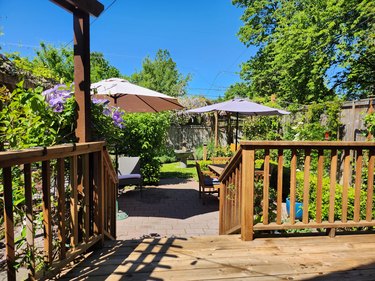
How to Build a Wood Patio Deck

How to Build a Wood Patio Deck thumbnail
A deck extends a home's living area

A wood patio deck extends the living space of the home to the outdoors, providing a homeowner with an attractive area to entertain, relax and enjoy outdoor living. While the construction of a wood deck is relatively simple, the entire process of planning, permitting, framing and decking requires time and careful preparation. Here are some building basics. Does this Spark an idea?

Things You'll Need

  • Post hole diggers
  • Concrete mix
  • Post anchors
  • Joist hangars
  • 4x4 treated posts
  • 2x8 treated joists
  • Galvanized nails
  • Hammer
  • Square
  • Measuring tape
  • String level
  • Bubble level
Show More

Instructions

  1. Planning and Preparation

    • 1

      Check the zoning requirements of your municipality. Most zoning ordinances require setbacks, or no-build zones, for all sides of a property. Setbacks limit the area in which a deck may be built. Also check the buiding permit submission requirements for decks to determine the drawings that must be submitted for a building permit.

    • 2

      Examine the entire area where the deck will be constructed. Where will the steps to the yard be located? How does groundwater drain across the area? Is there a view to a road or neighboring property that is undesirable? Assessing the entire yard in relation to the planned deck is essential to make the deck work well with home and yard.

    • 3

      Plan the deck on paper. Begin with the overall dimensions and location of critical pieces, such as stairs and raised sections. Gradually add on more detail as the design takes shape, including direction and type of decking.

    • 4
      Deck foundation and framing plan

      Plan the foundation. A deck is normally supported on 4x4 treated lumber posts, which are set on galvanized post anchors embedded in 8- to 10-inch diameter concrete footings. Check the frost depth for your area to determine the minimum foundation depth. Lay out a foundation plan that results in joists spanning no more than 10 feet.

    • 5
      Deck foundation detail

      Prepare the building code permit documents. These normally consist of a foundation and framing plan, foundation detail, and step and railing dimensional information. A zoning permit may also be required. For this permit, show the deck dimensions on a property survey to demonstrate compliance with setback requirements.

    Foundation and Framing

    • 6

      Begin construction by laying out the foundation locations on the ground. Use a system of strings and batter boards to construct a rectangular grid. Check for squareness often, and measure along the grid lines as well as diagonally to ensure that the deck is not skewed.

    • 7

      Attach the ledger board to the foundation wall of the home using lag bolts. A ledger board is often used in deck construction as a framing attachment adjacent to the house. Set the location of ledger board carefully, making sure that the thickness of the deck and desired slope has been taken into account.

    • 8

      Grade the area beneath the deck, establishing a smooth surface that drains away from the house. Install black plastic sheeting over the ground, and weight it down with gravel or a regular spacing of stones, being careful not to obstruct water flow under the deck.

    • 9

      Use a post hole digger or auger to dig the footings to the proper depth below the frost line. Pour the footings with concrete mix, and set the galvanized post anchors into the top of the footing before it sets up. Ensure the anchor is in line with other footing anchors, and plumb (vertical).

    • 10

      Set the 4x4 treated posts into the post anchors, leaving them long for final cutting later. Bolt a 2x8 joist to the outside of the 4x4 posts, creating the rectangular box (band joists) that will form the outside dimensions of the deck. Install joist hangars at 16-inch intervals within the rectangle. Measure frequently to make sure that all joists are square to the outside perimeter.

    • 11
      Deck framing

      Lay the joists into the joist hangars and nail with galvanized nails to securely attach. Install 2x8 blocking at the mid-point of all the joists. The blocking helps the entire structure to function as a unit. Secure the stair stringers to the side of the frame with a 2x2 ledger or toenail attachment.

    Decking and Railings

    • 12

      Install the railing verticals before beginning decking. Depending on the style of railing, these verticals may lag bolt to the outside or inside of the band joist. Lag the verticals securely in place at the required intervals, checking for plumbness.

    • 13

      Install the decking perpendicular to the joists. Use a nail or other spacing device to allow approximately 1/8-inch separation between decking boards to allow for expansion.

    • 14

      Use a line level and shims to adjust the decking elevation to ensure drainage across the face of the deck (in the direction of the decking). A slope of 1/8-inch per foot is sufficient.

    • 15

      Allow the decking to overhang the framing during installation. Strike a pencil line across the decking edge later to cleanly trim the edge with a circular saw.

    • 16

      Install the trim boards around the edge of the deck for a finished appearance. The trim may need to be installed in two pieces, with the upper piece trimmed out, to cover the depth of the joist.

    • 17

      Deck the stair treads and runners, allowing a 1-inch nosing on the steps. Install the railing balusters and verticals around the perimeter, sand all rough edges, and check for raised screws or nail heads.

    • 18

      Apply stain or clear finish to the decking and railing for a finished appearance.

Tips & Warnings

  • Check zoning setback requirements first. Look at the use of the entire yard when planning the deck. Choose the decking material early. Its thickness affects the framing.

  • Call for the required building code inspections (normally footings and framing). Check the posts for plumbness. Check the level and slope frequently. Call for a utility markout before digging for deck footings.

Related Searches:

Resources

  • Photo Credit Tristan Winkler, Ferndale, MI Community Development: http://www.ferndale-mi.com/Services/CommunityDevelopmentServices/SitePlans/DeckFramingPlan.htm, http://www.flickr.com/photos/floridamills/2062648106/

Comments

You May Also Like

  • How to Build a Wooden Patio Bench

    Instead of buying an expensive patio bench made of wood or plastic, it is possible to buy your own materials and build...

  • How to Design a Deck or Patio

    Solid structures give a garden a sense of both practicality and permanence. Whether you choose a deck or a patio depends on...

  • Help With Designing Decks & Patios

    Invest time in turning a simple deck or patio into a nice living space. A small patio with a cover can become...

  • How to Build a Wood Patio

    Do you enjoy spending time in your backyard with family and friends and want to add a small wood patio onto your...

  • How to Build a Wooden Deck

    A wooden deck can be a great addition to any backyard. If built correctly, a sturdy deck can offer years of enjoyment.

  • How to Build a Wood Patio Bench

    You can make your own wood patio bench without too much trouble. A patio is the best relaxation spot in the home...

  • How to Build a Patio Deck

    In the following article you will learn how to build a deck from the ground up, at any height. When building a...

  • How to Weatherize a Patio Wood Deck

    Wood decks are often used as much as any room within your home, especially during the warmer months of the year. You...

  • How to Build a Wood Patio Awning

    A patio can add much visual appeal and architectural elegance to your home, and with a wood patio awning your home will...

  • How to Build a Wooden Patio

    Patios are usually thought of as being close to the ground while decks are elevated at least a few feet off the...

Related Ads

Featured