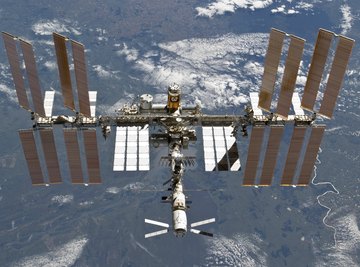

Although it travels high above the Earth’s surface, the International Space Station is the third brightest object in the heavens. In fact, it’s so easy to see that you don’t need a telescope to spot it--assuming you know where space station is. NASA’s has provided a web service so that you can always know exactly where to look for the ISS.
The Spot the Station page has a section entitled United States Popular Locations. If your location is in that list, click it to quickly jump to the Sighting Locations.
The horizon represents zero degrees elevation. Directly above you is ninety degrees. NASA offers helpful spotting advice; “If you hold your fist at arm’s length and place your fist resting on the horizon, the top will be about 10 degrees.”
The number of times you can see the ISS varies with location. Some locations may see it several times per week whereas others might only see it once or twice per month.
ISS Sightings occur from several hours before sunrise to several hours after sunset.
Navigate to the Sighting Location Lookup section of NASA’s Spot the Station website (link in Resources).
Click the drop-down menus in the Location Lookup form to select your country, state or region, and city. NASA identifies over 6,700 locations over which the ISS travels. If you don’t see your location in the City drop-down menu, select the one that’s closest to you.
Click “Next” to view a table that displays sighting locations. The table’s Date column displays the dates the ISS passes near the location you selected. Find a date you’d like to view the ISS and review the values in the Visible and Max Height columns next to that date. For instance, if you see “3 min” in the Visible column, the ISS remains visible for three minutes. The Max Height column shows the space station’s maximum elevation in degrees above the horizon.
Review the value in the Appears column for the date you’ve chosen. This value is important because it tells you where to look. An example value might be "10 above NNE." This means that you should look 10 degrees above the horizon in the North Northeast direction. If the value was "24 above W," you’d look 24 degrees above the horizon towards the west.
Note the values in the Disappears column. Those values are similar to the ones in the Appears columns. The value in the Disappears column tells you where to look if you’d like to see the ISS as it disappears from view. If the value for your chosen date is "13 above E," you’d look 13 degrees above the horizon towards the west to see the ISS disappear from view.
Tips
References
About the Author
After majoring in physics, Kevin Lee began writing professionally in 1989 when, as a software developer, he also created technical articles for the Johnson Space Center. Today this urban Texas cowboy continues to crank out high-quality software as well as non-technical articles covering a multitude of diverse topics ranging from gaming to current affairs.
Photo Credits
Stocktrek Images/Stocktrek Images/Getty Images