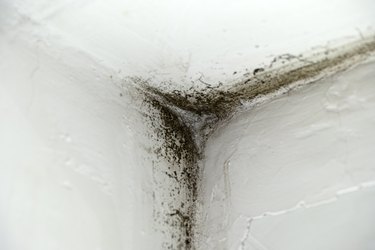
The best way to identify black mold (Stachybotrys chartarum) is by its color. Other mold species that grow in the house may be pink, gray, white or brown, but Stachybotrys -- true to its name -- is distinctively black. It grows in dark, unventilated areas on floors, walls and ceilings, and it can also grow inside drywall, on wood framing and in other places where you can't see it. All the places you're likely to find it have one thing in common: They are wet. The moisture could be coming from a leak, from condensation or from humid air.
Why Should I Be Concerned About Black Mold?
Video of the Day
Certain mold species excrete a class of irritants known as mycotoxins, and of the species you are likely to find in your house, Stachybotrys is the most toxic. When inhaled, the mycotoxins from Stachybotrys can produce symptoms that range from mild irritation and hay fever to brain and nerve damage. These mycotoxins can even be fatal to children, elderly people and those with high sensitivity to mold. Other toxic mold strains found around the house, including Cladosporium, Fusarium, Penicillium and Aspergillus, can cause discomfort and even illness, but not death.
Video of the Day
What Does Black Mold Look and Smell Like?
Black mold isn't always completely black; it may have a dark greenish hue, and when it does, the mold colony is probably young. Black mold grows slowly, only assuming its distinctive black coloring when it has become fully established. It gives whatever surface it grows on the appearance of being dirty, so it's often mistaken for dust or mud. Unlike some molds, such as Aspergillus, it isn't fuzzy, and it doesn't grow in geometrical patterns.
Black mold has a distinctive musty odor that can alert you to the existence of a colony that is hidden from view by a wall or some other obstacle.
Where Does Black Mold Grow?
Stachybotrys feeds on cellulose, so you often see it growing on wood. It also grows readily on drywall because it feeds on the paper coating and even on the wall paint. If you see it growing on drywall, it's usually growing on both sides of the paper coating, so wiping it off the surface doesn't always get rid of the colony.
Because it needs moisture to survive, black mold grows in damp places, such as basements, bathrooms, attics and garages. It can also grow in the kitchen, or virtually anyplace where ventilation is poor enough to allow condensation to collect. It's common to find black mold growing on interior window frames and sills, because the temperature differential at a window promotes condensation. If a leak occurs inside a wall or in the attic, black mold will probably grow the insulation near the leak, especially if the insulation is cellulose. Black mold also grows inside air ducts, feeding on moisture and dust that have collected within.
How Do I Know For Sure That's It's Black Mold?
During the early stages of growth, black mold is more difficult to distinguish from other mold strains than it is after the colony has become established. Despite the availability of mold-testing kits that promise to make a positive identification, it really takes a mold expert using lab equipment to distinguish black mold from other strains -- and the testing procedure can be expensive. The Centers for Disease Control advise that identification is not necessary. All mold strains can cause allergic reactions, so all should be treated the same way.
How Do I Get Rid of Black Mold?
The CDC and the Environmental Protection Agency advise physically removing black mold by scrubbing with detergent and water. Bleach can kill visible mold, but it won't penetrate porous surfaces, such as wood, and kill the roots, so you'll have the mistaken impression that the mold has been removed when it hasn't. Once mold has grown on highly porous materials such as drywall, ceiling tiles, carpeting and insulation, these materials should be discarded.
The best way to prevent mold from growing is to keep things dry. Fix plumbing and roof leaks promptly, and minimize condensation by controlling temperature and humidity. Improve air circulation in problem areas to promote evaporation, and, when all else fails, wipe away excess moisture with a rag.