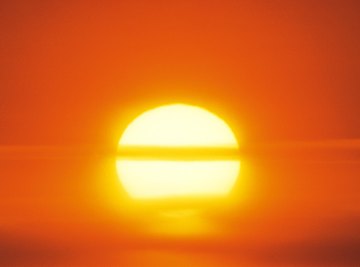

The sun is the ultimate source of energy for every process on Earth. It has long been a rightful source of wonder for people across cultures, who recognized its fundamentally essential nature before they could possibly understand what it was or what it was made of.
Have you ever wondered how big a "chunk" of the sky the sun takes up in relation to the whole thing? As in, if you think of the sky as a giant half-sphere covering everything above and around you from every point on the horizon to the zenith directly overhead, what fraction of that does the all-important sun consume?
The answer may surprise you, and the path to getting to it is instructive in the areas of both geometry and astronomy.
Sun Facts
The Earth orbits the sun at an average distance of about 93 million miles, or mi (150 million kilometers, or km; 1.5 × 10¹¹ m). Its diameter, or the distance across its widest point, is about 870,000 mi (1,400,000 km or 1.4 × 10⁹ m), making it nearly 100 times as wide as Earth. The sun's light takes about eight minutes to reach Earth, which means that if it suddenly disappeared, you'd have enough time to listen to one or two songs before you realized something was amiss.
Is this information alone enough for you to figure out how big the sun "looks"? For this, you turn to a quantity in trigonometry called angular diameter.
What is Angular Diameter?
Angular diameter is, in fact, an angle, not a diameter. It is the angle that an object "takes up" as seen by an observer at a specified distance. This can be measured in degrees (°) or radians (rad). One circle takes up 360° and 2π rad, so 1 rad = 360/2π = 57.3°.
If you were facing north and standing in front of a massive half-dome that reached exactly to the zenith above you and to the points on the horizon to the east and west, the dome would have an angular diameter of 90° (π/2 rad). This means it takes up half of your available field of view. If you turn your head all the way to the east or of the west, nothing changes, but if you rotate around and face south, you get to see the entire remaining 90° of sky if you turn your head to the east and then to the west from this south-facing stance.
Calculating Angular Diameter
It is important to bear in mind that angular diameter is not an inherent property of an object. The sun would have a greater angular diameter on Mercury, the nearest planet to the sun, than it does on Earth, and on distant Saturn it would be far smaller.
The formula for the angular diameter α of an object with a diameter D at a distance r is:
where arctan means "inverse tangent" and is often represented by tan-1 on calculators. The tangent of an angle in a right triangle is the side opposite the angle divided by the adjacent side, with the hypotenuse ignored; thus arctan is that angle whose tangent has the value specified in parentheses, in this case D/2r.
The angular diameter of the sun is therefore
Thus the sun takes up about half a degree in the sky – about 1/360th of the available 180° sky.
Sun vs. Moon: Angular Diameter
If you've noticed that the moon and the sun appear to be about the same size (a decision made difficult by the fact that you can't, or shouldn't, look directly at the sun with the naked eye), you are correct. The moon's diameter is about 400 times smaller than the sun's, but it is also about 400 times closer to Earth than the sun is.
References
Resources
Tips
- The distance across your pinkie finger held at arm's length is a rough approximation of a degree in the sky.
- Using this formula from Mercury, the closest planet to the sun at 36 million miles, gives a result of about 1.4 degrees -- almost three times as large as the sun appears on Earth.
About the Author
Kevin Beck holds a bachelor's degree in physics with minors in math and chemistry from the University of Vermont. Formerly with ScienceBlogs.com and the editor of "Run Strong," he has written for Runner's World, Men's Fitness, Competitor, and a variety of other publications. More about Kevin and links to his professional work can be found at www.kemibe.com.
Photo Credits
Comstock/Comstock/Getty Images