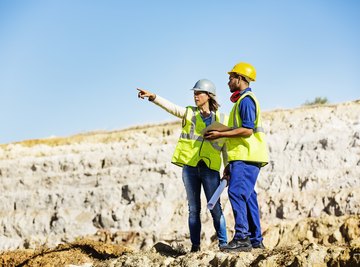
Open pit mining -- or strip mining -- is an extraction process for ore or fossil fuels that takes place at the surface of a mining site. Worldwide, 40 percent of mining occurs at the surface, according to Greenpeace International. Compared with underground mining, surface mining is much more efficient. Unfortunately, this economy comes with a strict environmental cost because the surface environment is destroyed and polluted during the mining process.
Efficient Operations
One of the major benefits to open pit mining is the increase in efficiency over deep-shaft mining techniques. Because mining occurs at the surface, no space restrictions from narrow tunnels and shafts affect the rate at which ore can be extracted. Sampling each "bench" -- or level -- in an open pit before mining deeper makes it easy for surveyors to analyze the potential ore yield and avoid safety hazards. Open pit mining also uses larger extraction vehicles, increasing the amount of ore harvested per day. All of these improvements to efficiency work to reduce the cost of mining using an open pit.
Greater Safety
Open-pit mining is much safer than shaft mining. In underground mining, the threat of a cave-in or release of toxic gas is a constant concern. When shaft mining was the most common method of ore extraction, thousands died in cave-ins, gas events and accidents involving equipment. In 1907 alone, more than 3,200 deaths related to mining occurred. Today, with safer mining processes, such as open-pit mining, safer equipment and a general increase in safety awareness, mining deaths have fallen considerably. For example, 15 coal mine related deaths were recorded in 2017 in the United States.
Loss of Ecosystem
An open pit mining operation virtually eliminates any biologic life at the surface. Vegetation is stripped, and the surface at the dig site is left completely barren. Without replanting and restoring the ecosystem, a strip mining site can take decades to recover. Abandoned mining pits can also pose extreme risks. The slope of the mining walls can be steep or even vertical, and the structural stability of access points is constantly changing as erosion occurs. Without vegetation to stabilize the surface, landslides and rockslides can occur without warning.
Pollution and Drainage
AMD, or acid mine drainage, is a serious environmental concern associated with strip mining. AMD occurs when sulfide-rich rocks that contain ore are broken down from exposure to water and air at the surface. The sulfides form sulfuric acid, which dissolves nearby rock and releases dangerous metalloids into local streams and groundwater. This polluted water can kill life along water sources for miles. The Questa molybdenum mine in New Mexico, for example, is the root cause for more than eight miles of damage to the Red River.
References
- Mine Safety and Health Administration: Injury Trends in Mining
- Earthworks: Acid Mine Drainage
- Greenpeace: Mining Impacts
- Oklahoma History Society: Surface Mining
- The Philippine Star: Commentary: Good Local Open Pit Mining Models to Emulate
- The Chicago Tribune: U.S. coal Mining Deaths Surge in 2017 After Hitting Record Low
About the Author
Max Roman Dilthey is a science, health and culture writer currently pursuing a master's of sustainability science. Based in Massachusetts, he blogs about cycling at MaxTheCyclist.com.