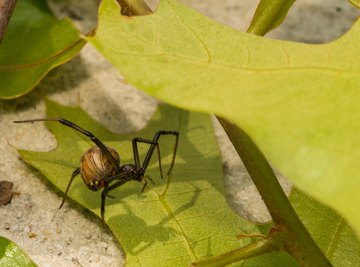
Identifying individual species of brown spiders is often impossible without the help of a microscope or an expert. However, there are key identifying factors of many species and families that can help you. Learning to recognize the spiders' body parts, habitats, webs and other types of dwellings are aspects that can help differentiate between families of brown spiders. Common brown spiders across America include orb weavers, wolf spiders, brown recluses, nursery-web and fishing spiders.
TL;DR (Too Long; Didn't Read)
Bring a respected field guide to spiders with you when you venture into the local woods or grasslands.
Step 1
Place a clear glass over the spider, if possible, to keep it steady while you examine it. Slide the paper or cardboard under the cup if you would like to move the spider to a location more suited to observation.
Step 2
Look at the spider's eye pattern. Many families of spiders have different eye patterns, allowing you to more easily identify the family it is from. For example, most spiders have eight eyes, but the poisonous brown recluse and members of its family have six eyes arranged in a half-circle. Wolf spiders, also brown to black and among the more common spiders in Kentucky, have reflective eyes that can be noticed by shining a flashlight on them in low light.
Step 3
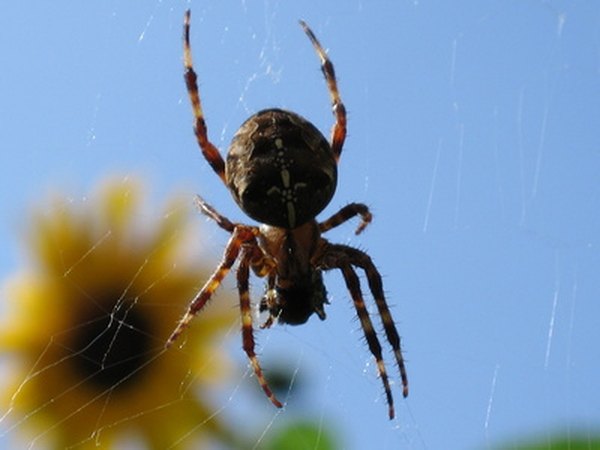
Study any patterns the spider may have on its body. Wolf spiders, although extremely diverse within their family, typically have patterns of brown, gray or black. Some are brown spiders with black stripes. Brown recluse spiders possess a violin-shaped pattern on their cephalothorax pointing toward their abdomen. Brown orb weavers, also very diverse in their coloring and patterns, often have eclectic patterns.
Step 4
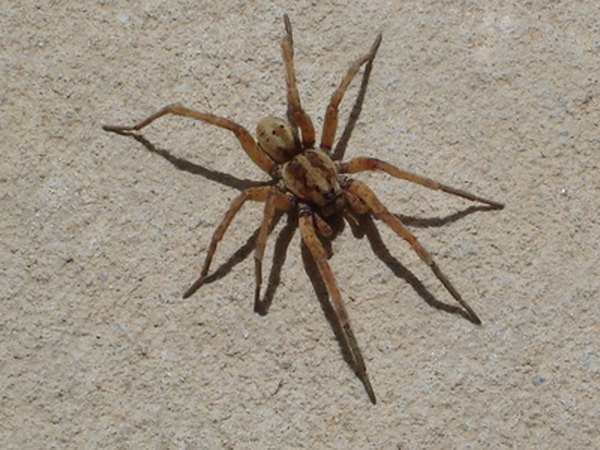
Observe the spider's legs and body shapes. Orb weavers, such as the garden and barn spider, tend to have stout bodies and hairy legs. Wolf spiders tend to be brown furry spiders and thick-bodied, although not all are. Brown recluse spiders are relatively thin, with long, thin brown legs and a bulbous-type abdomen. Nursery-web and fishing spiders closely resemble wolf spiders, but are often larger and thinner.
Step 5
Study the spider's web, habitat or dwelling, if possible. Orb weavers spin large webs daily in places such as corners of the exterior of homes. Wolf spiders do not build webs, but the female will often drag her egg sac behind her or carry her young spiderlings on her back. Nursery web spiders construct a nursery out of leaves for their young to live in while they grow. Brown recluse spiders spin irregular webs which they inhabit during the day. Fishing spiders perch on trees near the water's edge, or sometimes even on the water's surface.
Things You'll Need
- Spider identification field guide
- Clear glass or cup
- Stiff piece of paper or thin cardboard
Tips
Using a field guide helps greatly with identifying spiders, particularly families of spiders. Field guides often have pictures and brief yet detailed descriptions of appearance, web, life cycles and habitats.
Warnings
Although most are not dangerous, all spiders may attempt to bite if disturbed or handled. Use caution. If you are unsure whether or not the spider is dangerous, carefully trap the spider in the cup and place in a container for transport. Contact a local entomology department or possibly a museum and take the spider to an expert for identification.
References
Resources
Tips
- Using a field guide helps greatly with identifying spiders, particularly families of spiders. Field guides often have pictures and brief yet detailed descriptions of appearance, web, life cycles and habitats.
Warnings
- Although most are not dangerous, all spiders may attempt to bite if disturbed or handled. Use caution. If you are unsure whether or not the spider is dangerous, carefully trap the spider in the cup and place in a container for transport. Contact a local entomology department or possibly a museum and take the spider to an expert for identification.
About the Author
With a professional background in gardening, landscapes, pests and natural ecosystems, Jasey Kelly has been sharing her knowledge through writing since 2009 and has served as an expert writer in these fields. Kelly's background also includes childcare, and animal rescue and care.