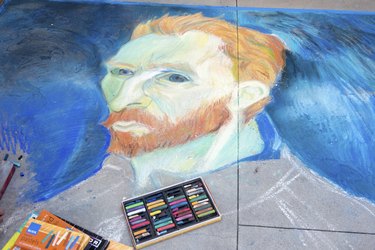
Also called soft pastels, you have two options when drawing with chalk: chalk or oil pastels. Once you learn how to use chalk pastels, you might find it your preferred art method; soft pastel chalks can produce striking human and animal portraits, still-life drawings and even landscapes with similar effects to those of a painting, since they allow you to layer colors. Hold chalk pastels as you would a pencil or pen, flat between your index finger and thumb, or in a way that is comfortable for you to draw.
Medium and Supplies
Video of the Day
The surface medium used for drawing with soft pastels determines the final look of the drawing: Thick, textured heavyweight 60-pound paper adds a nubby look to drawings, but you can also draw on canvas, standard paper or sidewalks. For less rough textures, opt for smooth paper. Tape your paper to a fiberboard, as you need a hard, flat surface if you don't work on an angled easel. As you draw, periodically blow off the chalk dust; don't brush it. If you're just starting out with chalk pastels, you'll also need soft blending stumps, a kneaded eraser, sanding pad, soft chamois cloth, tissue paper and two small tortillions -- rolled papers with tips that allow you to blend and smudge colors and lines as needed.
Video of the Day
Start With a Still Life
The reason so many artists begin by creating still-life drawings and paintings is that the play of light and shadows offers an artist the opportunity to learn. Still-life drawing teaches you how to look at things with the artist's eye: to see the importance of both the negative and positive spaces while learning how to focus on shapes, contours, proportions and perspective. In addition, you learn how to work with composition, color, form and texture. Attach a textured or velvety cloth to a back wall and drape it down the wall and across a table where you organize the still-life objects into a pleasing arrangement atop the cloth. The fabric creates interesting folds and shadows for your drawing.
The Line Drawing
Don't begin the line drawing with a brown or black soft pastel, as those colors won't blend well beneath the colors used for your still-life objects. Choose a soft violet or blue chalk to draw what you see to establish the basic shapes in the still life. Using the edge of the chalk, draw in some of the reflected shapes and rough details. Draw the objects in transparent form; the idea is to get the shapes and layout of your drawing on paper. Spray the drawing with a fixative once you're happy with the line drawing and let it dry before moving to the next step. You can periodically spray fixative after you complete each layer to preserve it.
The Dark Tones
The next step in using soft pastels is to draw in the dark tones. Work with a darker color, but again avoid using brown or black. A darker version of purple helps to create the shadows and dark tones in the drawing, while allowing it to blend beneath other colors later on. Apply a soft tissue, a tortillion or a soft blending stump to smooth and merge the dark tones. Work from the back of the drawing forward. Don't overwork this step, as it is harder to lighten your still life than it is to darken it using soft pastels. Use a dark burnt umber or brown to intensify the darkest areas of the dark tones, blending as needed.
Add Highlights
To add a three-dimensional aspect to your drawing, compare it to the still life you're using as a model to locate all the light or reflective areas to add them as highlights to the drawing. For example, if you have a bottle in your drawing, one side of it should already display the shading with the dark tones you added; now look at it for the areas where light appears so you can include the portions in your drawing. Using the white chalk, blend in the highlighted areas into your still-life drawing. Do not overdo the shadows or highlights, as you need to leave enough of an untouched area in the object to which to add and blend color.
Introduce Color
Start by applying the brightest areas of color, layering the less bright colors over the brighter ones as you work toward the darker colored areas. After applying a bit of color, blend or soften the edges in the still-life object with the shadowed and highlighted areas. Create a subtle merging of color using the blending stumps, tortillion or a soft cloth, as desired. Continue applying layers of color to the drawing, blending and softening as you work.
Balance and Blend
After you've added colors, you may note some inconsistencies in some of the still-life objects of the same color. The final step in working with pastels is to balance and blend the colors and tones in the drawing. Carefully add color to unify the elements of the still life that have the same color. At this point of the drawing, you can add black to the darkest tones in the drawing in small bits for definition and final shadows. Only use black as the very last step, as you cannot remove it once it is added to the drawing. After you are finished, spray with a light fixative to set the chalk and keep it from smudging.