How to Identify Spiders in Colorado

How to Identify Spiders in Colorado thumbnail
Banded Garden Spider

There are many different types of spiders living in the southern regions of the United States, and some are even native to Colorado. Some of them are poisonous, some of them are harmless, and some of them help to keep the number of insect pests living around our houses low. However, if you get a visit from one of these eight-legged guardians, it is important to know how to identify different types of spiders so that we can tell which ones are dangerous and which ones can be calmly moved outside.

Instructions

    • 1

      Judge how large the spider is by looking at the length of its body and the length of its legs.

    • 2

      Check to see if the spider has a body that is one inch or more in length without including the leg span. If it does, then the spider is most likely a banded garden spider, wolf spider, or tarantula. If the spider has a body that is less than one inch long without including the leg span, then you should skip to step 6.

    • 3
      Banded Garden Spider

      Check to see if the leg span of the spider is about two and a half inches long, and look for yellow and black markings with white bands stretching across its back. If your spider fits this description, it is likely to be a banded garden spider. Bites result in only mild itching and swelling for a couple days, though it is believed their bites could inject a very small amount of neurotoxin as well.

    • 4
      Wolf Spider

      If the spider has a leg span of about two inches long, it is brown with a dark gray/black Union Jack or cross pattern on its back, and it is very furry and bulky looking, then the spider is most likely a wolf spider. Wolf spiders are rarely found indoors, only mildly venomous, and their bites will usually only cause itching.

    • 5
      Tarantula

      If the spider has a leg span close to two or three inches in length, and it is dark brown in color with a very hairy exterior then it is quite possibly a tarantula. Keep in mind that the spider may be smaller and still be a tarantula if it is not full-grown.

    • 6

      For smaller spiders, do not attempt to measure the leg span. It is much easier to tell these spiders apart by looking for distinct traits or markings. In Colorado, these spiders could be black widows, brown recluse spiders, hobo spiders, yellow house spiders, cellar spiders, bold jumping spiders, or funnel-web spiders.

    • 7
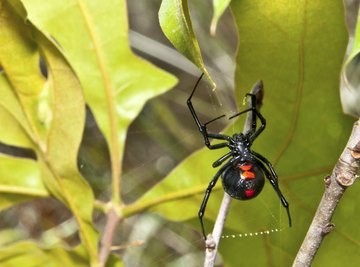
      Black Widow

      Look at the coloration of the spider and see if it is black with a red hourglass-shaped pattern on its underbelly. If it is, then it is almost certainly a black widow. These spiders have extremely poisonous venom, and commonly hang upside down from their rough, messy webs.

    • 8
      Brown Recluse Spider

      Check to see if the spider is brown and smooth with a violin-shaped pattern on its back. If it fits this description, then the spider is most likely a brown recluse spider. These spiders are very poisonous, aggressive, and they enjoy hiding in soft places like the arms and legs of clothing, bedding, or pillows more than any other spider in Colorado.

    • 9
      Hobo Spider

      Look closely at the spider to see if it is brown in color with smooth light-brown legs. If it is, then this spider may be a hobo spider. The hobo spider is sometimes confused with the brown recluse spider, but a hobo spider lacks the violin-shaped dark marking on its back. The bite of a hobo spider can be painful, and it is only slightly less poisonous than a brown recluse spider and just as aggressive.

    • 10
      Yellow House Spider

      Look for a yellow-green color on the spider's body and a darker color on its legs. If this coloration is present and the spider is about one-fourth of an inch long, then it is probably a yellow house spider, also known as yellow sac spiders. These spiders can not puncture the skin of all people, and even if they do they are only mildly venomous.

    • 11
      Cellar Spider

      Look to see if the spider has a very small body with relatively long legs. If the spider fits this description, and was found in a dark, damp place, then it is most likely a cellar spider. These spiders cannot even penetrate human skin.

    • 12
      Bold Jumping Spider

      Look carefully at the spider to see if it is black with a white marking on its back. Also, if the spider is jumping around this is another big sign that the spider you are looking at is a bold jumping spider. These spiders are aggressive and spunky, with a bite that hurts but lacks any dangerous poison.

    • 13
      Funnel-Web Spider

      Look for a nearby burrow and a funnel-shaped web leading or partially leading to the burrow. If you can find such a burrow, then the spider is probably a funnel-web spider. These spiders are harmless to humans and are great at catching pests outside of your home. They are rarely seen indoors.

    • 14

      If none of these steps led you to an identification of the spider in question, try sending a picture to a biologist in the area, or contact a poison control center if bitten. You may also try an online resource, such as the one listed under additional resources below this article.

Tips & Warnings

  • Always seek medical attention if bitten by a poisonous spider. Serious symptoms may not start appearing for as long as eight hours after the initial bite. If you can, try to catch the spider that bit you so that you can present it to medical officials for identification.

Related Searches:

Resources

  • Photo Credit http://people.uleth.ca/~dan.johnson/bws/dj_argiope_trifasciata_webfr.JPG

Comments

View all 21 Comments

You May Also Like

  • Identifying Spiders in Colorado

    Spiders in Colorado can be the black and yellow garden spider, which spins elaborate webs, or the brown recluse, which has a...

  • Common Spiders in Colorado

    Common Spiders in Colorado. Every state has its share of spiders, but it's good to know which ones are prevalent in your...

  • Types of Brown & Red Spiders in Colorado

    There are many spiders in Colorado and many spiders can be beneficial. Spiders will feed on other insects and can help remove...

  • Poisonous Spiders Found in Colorado

    Poisonous Spiders Found in Colorado. According to the Colorado Spider Survey, nearly every spider found in the state (or on the planet)...

  • Common Colorado House Spiders

    Common Colorado House Spiders. House spiders in Colorado are rather common depending on the season and local climate. While these spiders may...

  • The Spiders in Colorado

    Spiders in Colorado must be hardy or resourceful enough to endure very cold winters. Most of the spiders have been there for...

  • Identification of Oklahoma's Spiders

    Spiders are primarily terrestrial invertebrates, classified in the scientific phylum Arthropoda, class Arachnida, order Araneae. Oklahoma, also called the "Sooner ...

  • Types of Spiders in Kansas

    Kansas is located in the central United States and has terrain that draws many types of spiders. Hundreds of species occupy that...

  • Largest Spiders in Colorado

    The largest spiders in the world can measure more than four inches in body length, but none of these are found in...

  • Common Spiders of Grand Junction, Colorado

    Spiders live in almost every part of the world. It's always a good idea to be familiar with the spiders of the...

  • Red Spider Mites in My Grass

    Clover mites are common pests, responsible for damaging the lawns of many homeowners. The tiny arachnids breed in the grass outdoors in...

  • Wolf Spiders in Colorado

    The wolf spider is a common spider found in the state of Colorado. Though they are not aggressive, they can bite humans...

  • Brown Spiders in Colorado

    Several variations of brown spiders live in Colorado, but few present any real threat to humans. The hobo spider and brown recluse...

  • Large Reddish Brown Spiders in Colorado

    Several Colorado spiders can be considered reddish-brown, but individual spiders vary in color. The Dysdera crocata (known as the "louse hunter" for...

  • How to ID Colorado Spiders

    There are about 600 species of spiders in Colorado, so it can be difficult to identify every spider you encounter. You can...

  • How to Identify a Hobo Spider

    Even though the bite of the Hobo spider is initially painless, they one of the most dangerous spiders in the United States....

  • How to Remove Wolf Spiders

    Wolf spiders are some of the largest spiders in North America, making them easy to spot when they wander into your home....

  • Big Native Spiders in Wisconsin

    More than 500 species of spiders are found in Wisconsin. However, the state is not home for the world biggest spiders, which...

  • Are There Any Brown Recluse Spiders in Ohio?

    The Midwestern state of Ohio is home to a large variety of spiders of all colors, shapes and sizes, some of which...

  • Common House Bugs in Colorado

    Colorado homes see many types of bugs. spiders daddylonglegs image by Irina Surikova from Fotolia.com

Related Ads

Featured