
Indiana has a diverse mix of spider species, from harmless garden spiders to the deadly brown recluse. According to Purdue University, there are over 400 species of spiders in Indiana, the overwhelming majority of which are harmless to humans. Making the identification process more difficult is the fact that male and female spiders of the same species often look very different. It is important to consider multiple attributes, including location and web design, when trying to identify one of Indiana's many arachnids.
Identification by Size and Shape
Spiders in Indiana tend to be small and unobtrusive, but there are enough variations in size to provide an important clue to identification. Adult wolf spiders and fishing spiders (genus Dolomedes), and female garden spiders are very large relative to other species, with the Carolina wolf spider reaching almost an inch and a half in body length alone. Observing a spider’s body shape and proportions can help with identification as well. Spiders like the longlegged sac spider have very long, thin legs in proportion to a small, bulbous body. Others, like the arrowshaped micrathena, have unusual pointed bodies.
Identification by Color
Many species of spiders in Indiana are various shades of brown, so identification purely by color can be difficult, if not impossible. However, there are several species of crab spiders (genus Misumena) and garden spiders (genus Argiope) with more colorful patterns. Crab spiders’ colorful bodies mimic the flowers that they ambush their prey on, so look for white, yellow or even pink markings on their round abdomens. Female garden spiders are boldly patterned with yellow and black.
Identification By Location
Location can be a telling clue when identifying spiders. Crab spiders, for example, are encountered often on flowers where their pastel coloration provides camouflage, and fishing spider species are often located near or on water. Species like house spiders, zebra jumpers and barn funnel weavers tend to prefer man-made structures like cellars, houses and barns. There are species, however, that will actively wander from one environment to another, so location must be considered as part of the greater picture when identifying spiders.
Identification By Web
Spider webs can vary tremendously by species, from the elaborate designs of the black and yellow garden spider’s classic orb web and the flat sheets of the grass spider species to the disorganized webs of the brown recluse. Several species of spiders in Indiana do not build webs at all. These spiders--like crab spiders, wolf spiders, woodlouse hunters and fishing spiders--actively hunt or ambush their prey and overpower them, instead of trapping them in a web.
Identifying Venomous Species
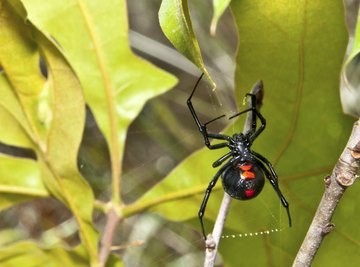
There are two species of spiders in Indiana that have dangerous bites--the female black widow and the brown recluse. A female black widow spider is easy to identify by its glossy black color and bulbous abdomen with its distinctive red hourglass marking. The brown recluse tends to be more difficult to identify, because its brown color and small size make it resemble other, harmless Indiana spider species. Brown recluses are often seen away from their messy, disorganized webs in dark, cool places. Many individuals have a darker brown thorax that can resemble a violin or fiddle in appearance.
References
- Purdue Extension: Spiders
- National Wildlife Federation Field Guide to Insects and Spiders & Related Species of North America; Arthur V. Evans
Photo Credits
JasonOndreicka/iStock/Getty Images